Look at what fashion sells, then look at who it shows. The two barely overlap.
Most people wear clothes that fit a body the industry rarely puts on a runway or in a campaign. That mismatch isn’t a feeling. It’s measurable, and the numbers have gotten worse over the last few years, not better. Here’s what the data says, and why the gap between the runway and real life matters more than any single trend.
The runway keeps shrinking
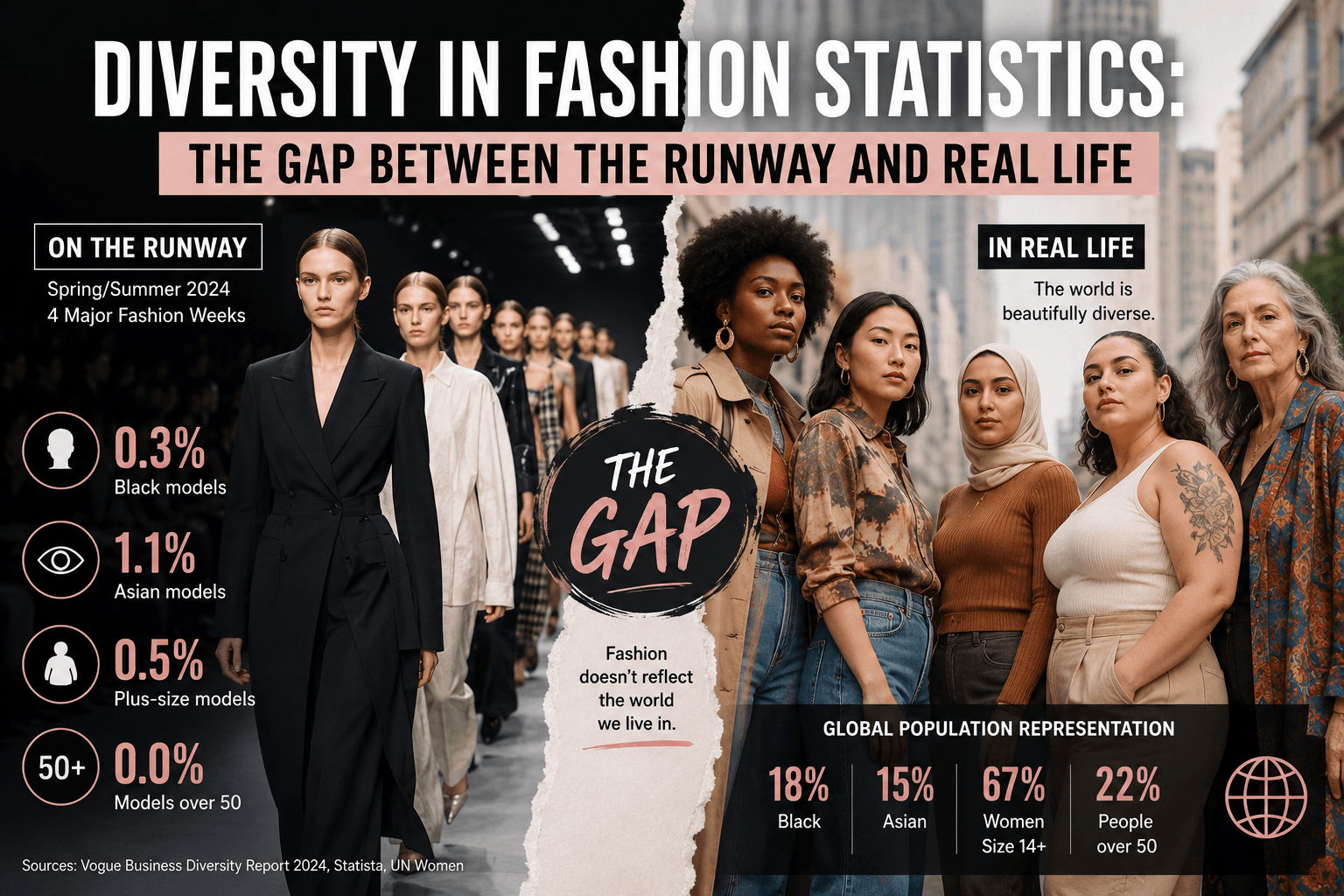
Vogue Business tracks body size at every major fashion week, and the picture for Spring/Summer 2026 is stark. Of the 9,038 looks shown across New York, London, Milan, and Paris, 97.1% featured models in the smallest sizes. Plus-size looks made up 0.9%. Regular-size models, meaning the middle where most people live, accounted for just 2%.
That isn’t a one-season blip. At the Autumn/Winter 2025 shows, plus-size representation fell to 0.3% of looks, down from 0.8% the season before. The drop shows up in headcount too. London Fashion Week went from 80 plus-size model appearances in September 2024 to just 26 the following February, and New York, Milan, and Paris all slid the same way.
The brief wave of body positivity that peaked around 2020 has receded, and the runway has drifted back toward a single, narrow ideal. So the aspirational image at the top of the industry represents almost nobody.
Who’s closing the gap
The interesting shift isn’t happening on the main runways. It’s happening in the brands built specifically for the bodies the mainstream keeps skipping.
Categories that used to get dismissed as too small to bother with are the ones growing fastest. Adaptive clothing for disabled wearers. Post-mastectomy bras. Extended sizing that goes well beyond a token 16. Intimate apparel designed around bodies the standard size chart was never drawn for. These aren’t charity projects. They’re businesses answering demand the big houses left on the table.
“The numbers only surprise you if you’ve never had to shop from the margins of a size chart,” says Gaff and Go, a body-inclusive intimate apparel brand. “When you design for the bodies the industry treats as an afterthought, you stop waiting for the runway to catch up and just build the thing people need.”
That’s the pattern across every one of these categories. The innovation comes from the edges, from people who lived the gap and decided to fill it, while the center of the industry keeps casting the same narrow few. And because these brands start from a real body rather than a sample size, the fit tends to be better, which is exactly why their customers stay.
Now look at who’s buying
Here’s the part that makes the runway numbers hard to defend. In the US, 54.4% of women wear a size 14 or above, according to Mys Tyler’s 2024 data drawn from more than 42,000 women. The majority. Not a niche, not an edge case, the center of the market.
And they’re spending. The global plus-size clothing market was worth roughly $294 billion in 2024 and is projected to reach around $445 billion by 2032. That’s not a rounding error the industry can afford to ignore. It’s a growth engine most of fashion is choosing to underserve.
Put the two facts side by side and the logic falls apart. The people fashion shows least are the people fashion sells most to. When a customer keeps seeing bodies that look nothing like hers, the message lands whether the brand means it or not: you weren’t really the point.
The gap runs deeper than sizing
Body size is the most visible measure, but it isn’t the only one. The British Fashion Council, working with the MBS Group, tracks who holds power inside the industry, and the picture there is just as lopsided.
In their research, ethnic minority leaders held 10% of board seats, 11% of executive committee roles, and only 6% of direct-report positions. A third of fashion’s non-executive boards had zero ethnic diversity at all. And despite fashion’s reputation as a women’s industry, only 15% of the top-twenty fashion groups were led by a woman CEO.
The rooms where the decisions get made, what to show, who to cast, which body to design for, don’t look much like the people those decisions affect. That’s how you end up with a runway that represents around 3% of the population and a boardroom that reaches the same conclusion season after season. Representation on the catwalk and representation in the boardroom aren’t separate problems. They’re the same one, seen from two ends.
Why the numbers are worth watching
It’s tempting to read a stat like “0.9% plus-size” and move on. Don’t. These figures track something real about who fashion thinks it’s for, and every season the answer narrows. A runway is a bet on what people want to see. Right now the industry keeps placing the same bet and getting the same result.
The encouraging thing is that the market is voting the other way. Shoppers are spending on brands that fit them, following accounts that show bodies like theirs, and drifting away from the ones that don’t. The runway can hold out for a while. The revenue won’t wait forever.
The gap between the runway and real life is measurable, it’s widening at the top, and it’s being closed from the bottom up. If you want to know where fashion is genuinely heading, watch the brands designing for the people the numbers keep leaving out. They’re the ones building the version of the industry that reflects how people live, and look, and shop.