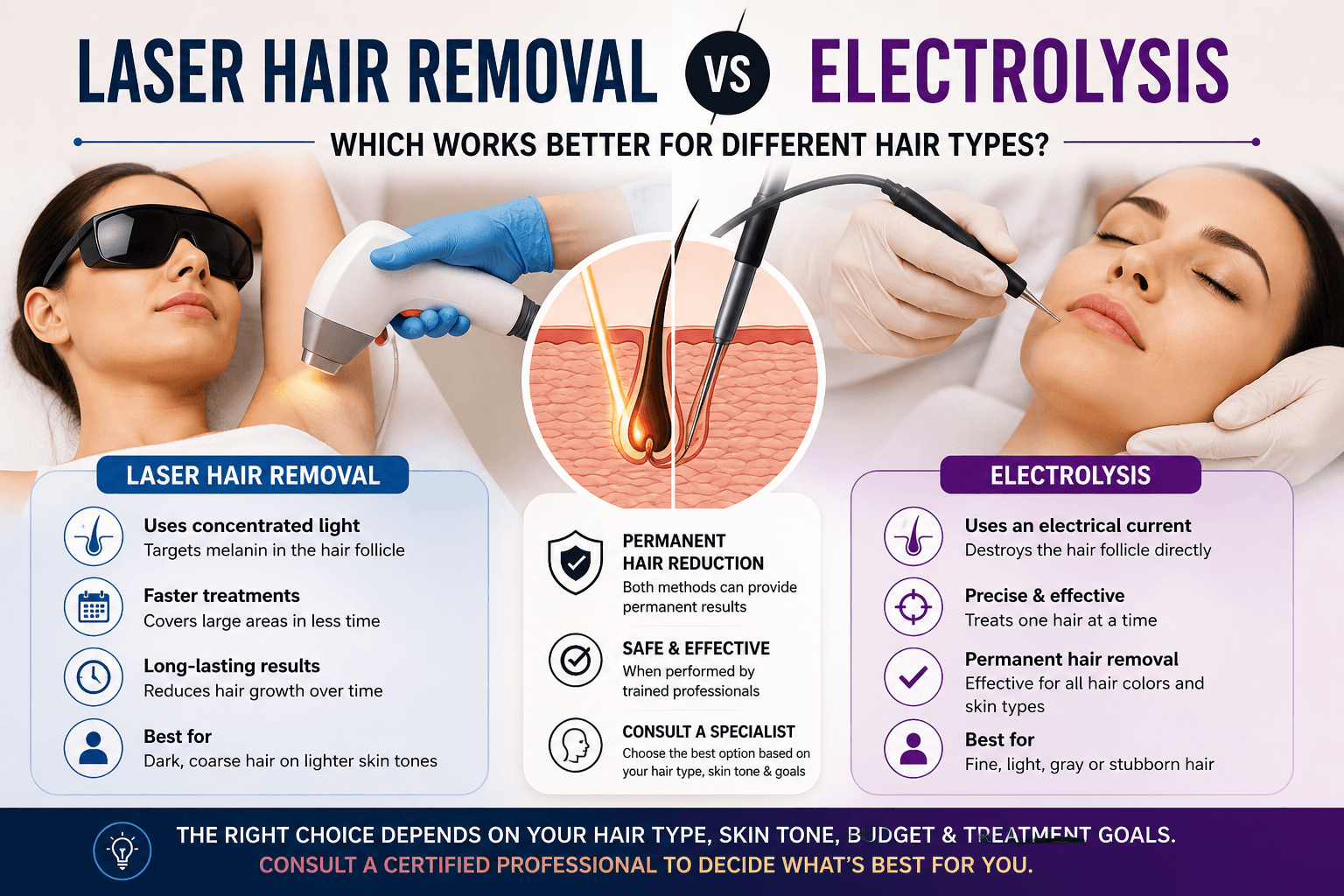
Choosing between laser hair removal and electrolysis is not simply a matter of deciding which treatment is more effective. The better option often depends on the type of hair you want to remove.
Dark, coarse hair behaves very differently from blonde, red, gray, or white hair during light-based treatment. Hair density, treatment area, skin tone, and the number of hairs that need to be removed can also affect which method is more practical.
The biggest difference is how the two technologies work. Laser hair removal uses light energy and relies heavily on pigment within the hair as a treatment target. Electrolysis works on individual follicles and does not depend on hair color in the same way.
Understanding this difference makes it much easier to determine which method may be better suited to different hair types.
Quick Answer: Laser Hair Removal vs Electrolysis
Laser hair removal is generally better suited to dark, coarse, pigmented hair, especially when treating larger areas. It can target many hairs during a treatment session and is commonly used for areas such as the legs, back, underarms, bikini area, and face.
Electrolysis is often more suitable for blonde, gray, white, and some red hairs because it does not rely on melanin within the hair to create the treatment effect.
Electrolysis can also be useful when only a small number of individual hairs remain.
For people with a mixture of dark and light hairs, the most practical approach may sometimes involve using laser hair removal for suitable pigmented hairs and electrolysis for hairs that cannot be effectively targeted with light.
What Is the Difference Between Laser Hair Removal and Electrolysis?
Although both treatments are designed to reduce unwanted hair, they use completely different methods.
Laser Hair Removal
Laser hair removal directs concentrated light toward pigmented hair. Melanin within the hair absorbs part of this energy, which is converted into heat and used to affect structures associated with continued hair growth.
Because pigment plays such an important role, the color and thickness of the hair can strongly influence treatment suitability.
Dark, coarse hairs generally provide a stronger optical target than very light or non-pigmented hairs.
Electrolysis
Electrolysis treats hair follicles individually. A very fine probe is inserted into the follicle opening and electrical energy is applied to affect the follicle responsible for producing the hair.
The process does not require the hair itself to contain large amounts of melanin. That distinction is especially important for people with blonde, gray, or white hair.
However, because each follicle is treated separately, electrolysis can require considerably more time when thousands of hairs need to be addressed.
Laser Hair Removal vs Electrolysis for Dark Hair
Dark hair is usually the type most naturally suited to laser hair removal.
Brown and black hairs typically contain substantially more melanin than blonde, gray, or white hairs. This gives a hair-removal laser a clearer optical target.
Hair thickness matters too.
A thick, dark terminal hair usually presents a stronger target than a very thin, lightly pigmented hair. This is one reason someone with coarse dark leg hair may have a very different experience from someone trying to treat fine facial hair.
For large areas containing dense dark hair, laser treatment also has an important practical advantage: it can address many hairs across the treatment area without requiring each follicle to be treated individually.
For this reason, laser hair removal is commonly considered when treating dark hair on areas such as:
- legs;
- arms;
- underarms;
- back;
- chest;
- bikini area; and
- larger facial areas with suitable hair.
Laser Hair Removal vs Electrolysis for Blonde Hair
Blonde hair creates a more complicated situation.
The term “blonde hair” covers a wide spectrum. Dark blonde hair can contain noticeably more pigment than very pale blonde hair, so not every blonde hair will respond in exactly the same way.
However, as the amount of melanin decreases, conventional laser hair removal generally has less pigment available to target.
That means very light blonde hair can be a poor candidate for pigment-dependent hair-removal technologies.
Electrolysis avoids this particular limitation because the treatment is directed at individual follicles rather than relying on the hair to absorb laser energy.
For a relatively small number of persistent blonde hairs, electrolysis may therefore be the more practical method to consider.
Laser Hair Removal vs Electrolysis for Gray Hair
Gray hair often contains significantly less pigment than the darker hair a person may have had earlier in life.
As the hair loses melanin, it becomes progressively more difficult for conventional hair-removal lasers to use that pigment as an effective target.
This is why someone who previously responded well to laser treatment on dark hair may find that newly developed gray hairs behave differently.
Electrolysis does not depend on the remaining pigment within the hair. As a result, gray hairs can still be treated individually even when they no longer provide a strong target for laser energy.
Laser Hair Removal vs Electrolysis for White Hair
White hair represents one of the clearest differences between laser hair removal and electrolysis.
Conventional hair-removal lasers depend heavily on pigment. A white hair contains very little or no melanin available to function as the intended optical target.
Changing from one conventional hair-removal laser wavelength to another does not restore pigment that is no longer present in the hair.
For this reason, consumers should be cautious about broad claims that every hair color can be treated equally well with laser technology.
Electrolysis has an advantage here because the follicle can be treated individually without requiring the visible hair to contain substantial pigment.
For isolated white facial or body hairs, electrolysis may therefore be considerably more practical than repeatedly attempting pigment-dependent laser treatment.
What About Red Hair?
Red hair is another category where treatment results can be less straightforward.
The pigment composition of red hair differs from typical dark brown or black hair. The amount and type of pigment can also vary considerably between people.
Dark auburn hair, for example, should not automatically be treated as equivalent to very pale red or strawberry-blonde hair.
Some darker red hairs may provide a more useful optical target than very light red hair, but treatment suitability should be evaluated individually.
When the hair does not provide enough suitable pigment for effective laser targeting, electrolysis remains an option because it does not rely on hair color in the same way.
Laser Hair Removal vs Electrolysis for Fine Facial Hair
Facial hair deserves special attention because color alone does not determine whether laser treatment is appropriate.
A person may have dark facial hair that is extremely fine. Another person may have a small number of coarse chin hairs mixed with lighter hairs.
These situations should not automatically receive the same treatment.
Laser hair removal tends to make the most sense when there is enough suitable pigmented hair to provide a useful treatment target.
Electrolysis may become more practical when there are only a few unwanted hairs or when the hairs are too lightly pigmented for conventional laser targeting.
This makes the face a good example of why choosing between the two methods should be based on the actual characteristics of the hair rather than simply the body area.
Does Skin Tone Affect the Choice?
Yes. When considering laser hair removal, hair characteristics cannot be separated completely from skin characteristics.
Melanin is present in both pigmented hair and skin. A laser treatment therefore needs to deliver useful energy to the intended hair target while managing exposure to the surrounding skin.
Different laser technologies, wavelengths, pulse durations, cooling systems, and treatment parameters can be used for different patient profiles.
This does not mean that people with darker skin cannot receive laser hair removal. It means that appropriate technology selection and treatment parameters become especially important.
Electrolysis does not depend on the same optical contrast between the hair and surrounding skin, although appropriate technique and professional assessment are still important.
Which Is Better for Large Treatment Areas?
When thousands of suitable hairs need to be treated, laser hair removal usually has a major practical advantage: speed.
Consider someone who wants to reduce dense dark hair across both legs.
Treating every follicle individually with electrolysis could require a substantial time commitment. Laser treatment can instead deliver light across successive areas containing multiple hairs.
That makes laser particularly attractive for larger areas containing dark, appropriately pigmented hair.
Common examples include:
- full legs;
- back;
- chest;
- arms;
- underarms; and
- larger bikini areas.
The advantage becomes smaller when only a few individual hairs need treatment.
Which Is Better for Small Areas or Individual Hairs?
Electrolysis becomes especially useful when the treatment goal involves individual hairs rather than a large field of hair.
Imagine someone who has only ten persistent white chin hairs.
The ability of laser treatment to cover a large area quickly provides little advantage in this situation because the hairs themselves contain insufficient pigment for conventional laser targeting.
Treating those individual follicles directly with electrolysis may make more sense.
Situations where electrolysis may be worth considering include:
- isolated chin hairs;
- white facial hairs;
- gray hairs;
- light blonde hairs;
- small areas of persistent unwanted hair; and
- individual hairs remaining after previous laser treatment.
Laser Hair Removal vs Electrolysis: Which Is More Permanent?
The word “permanent” is one of the biggest sources of confusion when comparing these two treatments.
Laser hair removal is generally better understood as a method for achieving long-term or permanent hair reduction. A successful treatment course can substantially reduce the number, density, and visibility of hairs that regrow, but it should not automatically be interpreted as a guarantee that every treated hair will disappear forever.
Electrolysis approaches the problem differently by treating individual follicles. When a follicle is successfully treated, the goal is to prevent that particular follicle from continuing to produce hair.
However, this does not mean electrolysis is automatically the better choice for every person.
Permanence is only one factor. Treatment time, hair density, treatment area, hair color, cost, discomfort, and the total number of follicles requiring treatment can all affect the decision.
Laser Hair Removal vs Electrolysis: Which Is Faster?
For large areas of suitable pigmented hair, laser hair removal is generally much more efficient.
The difference comes from how treatment is delivered.
Laser treatment can address multiple hairs across a treatment area, while electrolysis requires individual follicle treatment.
If someone has dense dark hair across the back or legs, this difference can become substantial over the course of treatment.
For a small number of isolated hairs, however, overall treatment speed becomes less important. In those cases, the ability to target an individual follicle regardless of hair color can make electrolysis more practical.
Laser Hair Removal vs Electrolysis: Which Hurts More?
Both treatments can cause discomfort, but the sensation is different.
Laser hair removal is often described as producing brief pulses of heat, snapping, stinging, or warmth. Modern professional systems may use contact cooling, cold air, or other cooling methods to improve comfort and protect the skin.
Electrolysis involves treating follicles one by one, so the patient may experience a brief sensation each time energy is delivered.
Pain tolerance varies significantly between individuals. The treatment area also matters: the upper lip or bikini area, for example, may feel more sensitive than other areas.
For this reason, it is difficult to declare one method universally less painful.
Can You Combine Laser Hair Removal and Electrolysis?
For some hair profiles, laser hair removal and electrolysis do not have to be treated as competing choices.
A person may have thousands of dark hairs together with a smaller number of blonde, gray, or white hairs.
In such a situation, a professional may consider different approaches for different hair populations.
Laser treatment may be used to reduce large numbers of suitable pigmented hairs, while electrolysis may later be considered for individual light-colored hairs that remain.
This is one reason a detailed electrolysis vs laser hair removal comparison should consider more than just which technology is described as permanent. Hair color, treatment area, cost, treatment time, and the number of remaining hairs can all change the answer.
Laser Hair Removal vs Electrolysis by Hair Type
| Hair Type or Situation | Laser Hair Removal | Electrolysis |
|---|---|---|
| Dark, coarse hair | Often well suited | Possible, but slower for large areas |
| Dense hair over a large area | Usually more practical when hair is suitably pigmented | Can require substantial treatment time |
| Dark but very fine hair | Suitability varies | Can target individual follicles |
| Blonde hair | Often difficult when pigment is limited | Does not depend on hair melanin |
| Gray hair | Often a poor optical target | Can treat individual follicles |
| White hair | Generally unsuitable for conventional pigment-dependent targeting | Often the more practical option |
| Red hair | Response can vary considerably | Not dependent on hair color |
| A few isolated hairs | Speed advantage becomes less important | Well suited to individual follicle treatment |
| Mixed dark and white hairs | Useful for suitable dark hairs | Useful for remaining non-pigmented hairs |
How to Choose Between Laser Hair Removal and Electrolysis
Rather than asking which technology is universally better, start by evaluating the characteristics of the unwanted hair.
1. What Color Is the Hair?
Dark brown and black hairs generally provide the strongest targets for conventional laser hair removal.
Blonde, gray, white, and some red hairs may be better suited to electrolysis when there is insufficient pigment for effective optical targeting.
2. How Thick Is the Hair?
Coarse terminal hairs usually provide a stronger laser target than extremely fine hairs.
Do not assume that every dark hair will respond identically simply because it contains pigment.
3. How Large Is the Treatment Area?
Laser hair removal becomes particularly attractive when large numbers of suitable hairs need to be treated.
Electrolysis becomes more practical when the number of hairs is relatively small.
4. What Is Your Skin Tone?
Skin characteristics matter when selecting laser technology and treatment parameters. Professional evaluation is particularly important when there is more melanin within the surrounding skin.
5. Are You Looking for Hair Reduction or Individual Hair Removal?
Someone trying to substantially reduce dense body hair has a different goal from someone trying to permanently address a handful of white chin hairs.
The desired endpoint should therefore be part of the treatment decision.
Common Mistakes When Comparing Electrolysis and Laser Hair Removal
Assuming All Hair Colors Respond the Same Way
They do not. Hair pigment is one of the fundamental reasons laser suitability varies between dark, blonde, gray, white, and red hair.
Assuming “Laser” Means Every Hair Can Be Removed
A laser requires an appropriate optical target. White hair does not suddenly become a suitable target simply because a different machine is used.
Choosing Only by Treatment Price
The price of one appointment does not necessarily reflect the total treatment commitment.
The number of sessions, size of the treatment area, number of follicles, and amount of remaining hair all matter.
Ignoring Hair Density
Treating twenty hairs is fundamentally different from treating twenty thousand. The efficiency of the technology matters much more as the number of hairs increases.
Expecting Identical Results From Every Person
Hair growth patterns, skin characteristics, treatment parameters, hormonal influences, previous hair-removal methods, and individual biology can all affect results.
Final Verdict: Which Is Better for Different Hair Types?
There is no universal winner in the laser hair removal vs electrolysis debate. Each technology has a different strength.
Laser hair removal is generally the more practical choice for large numbers of dark, coarse, suitably pigmented hairs. Its ability to treat multiple hairs across an area makes it particularly useful for larger body regions.
Electrolysis becomes especially valuable when hair contains little or no suitable pigment. Blonde, gray, white, and some red hairs may therefore be better candidates for individual follicle treatment.
Electrolysis can also make sense when only a limited number of hairs remain, while laser may make more sense when thousands of appropriate hairs need to be reduced.
For people with mixed hair colors, the most sensible strategy may sometimes involve both technologies rather than forcing every hair into a single treatment method.
The better question is therefore not simply “Is laser or electrolysis better?”
It is: Which technology best matches the color, thickness, density, treatment area, skin characteristics, and number of hairs you actually want to remove?