
Most Indian women have tried at least one skincare routine they found online – and most of those routines were built for someone in Korea or the US. Different climate, different skin, different problems. So it didn’t work. That’s not your fault.
Indian skin deals with things no Western article thinks about – hard water, humidity that switches overnight, pollution settling deep into your pores, and sun that doesn’t ask permission before leaving a dark spot. A routine that actually works for you has to start from that reality. That’s exactly what Tezvi focuses on – skincare built around the conditions Indian skin actually lives in.
This guide does exactly that.
Why Indian Skin Is Different (And Why It Matters for Your Routine)
Indian skin has higher melanin levels. That’s what gives it its warmth and colour – but it also means your skin reacts to inflammation differently. Any irritation, whether from sun, a harsh product, or even a small pimple, is more likely to leave behind a dark mark on brown skin than on lighter skin tones.
Add to that: most Indian cities have hard water. Hard water has high mineral content, and when you wash your face with it daily, it slowly disrupts your skin’s natural barrier. This is why many women feel tight and dry after washing, or notice their cleanser doesn’t lather well. It’s not the product – it’s the water.
Then there’s the climate. India moves from dry winters to humid summers to sticky monsoons. Your skin doesn’t need one routine – it needs a routine that can adjust.
How to Know Your Skin Type (The Indian Climate Version)
Here’s the problem with the standard skin type test: it assumes a neutral environment. India is rarely neutral.
Do this instead – wash your face gently at night, don’t apply anything, and check your skin the next morning before stepping outside.
- If it feels oily all over, including your cheeks, that’s oily skin.
- If it pulls or feels tight, especially around the jaw and cheeks, that’s dry skin.
- If only your forehead, nose, and chin feel oily but your cheeks feel normal or slightly dry, that’s combination skin.
- If your skin reacts to most products with redness or itching, that’s sensitive skin.
One important note: in humid cities like Mumbai or Chennai, dry skin often looks oily because of sweat. Don’t treat oily symptoms when the actual problem is dehydration.
The Morning Skincare Routine for Indian Women
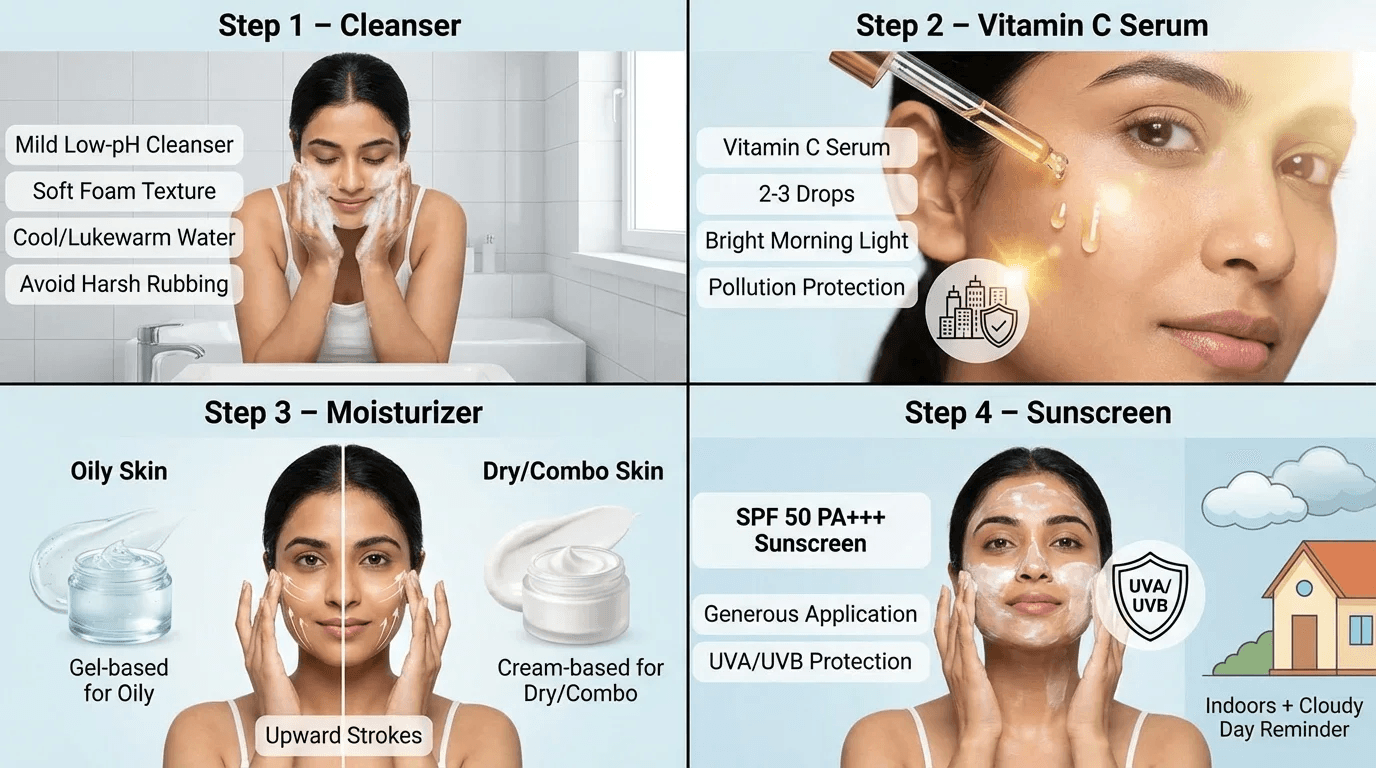
Morning skincare has one job: protect your skin for the day ahead. Keep it simple.
Step 1 Cleanser
Wash with a mild, low-pH face wash. Water temperature matters more than most people realize – hot water strips your natural oils and worsens dryness. Use lukewarm or cool water. If you have oily or acne-prone skin, a gentle gel or foam cleanser works well. For dry skin, go with a cream-based face wash that doesn’t leave your skin feeling stripped after rinsing.
Step 2 Vitamin C Serum
This is the most important morning step for Indian skin specifically. Vitamin C fights the oxidative damage that pollution causes every day, and it gradually works on pigmentation and uneven tone – two of the most common concerns for Indian women. Apply 2 to 3 drops on dry skin and let it absorb for a minute before the next step.
One honest note: some Vitamin C serums leave a slight yellow tint on skin. This is normal and fades within minutes. It’s not a reaction – it’s just the oxidation of the serum itself.
Step 3 Moisturizer
Yes, even if you have oily skin. When oily skin doesn’t get enough moisture, it produces more oil to compensate. Use a gel-based, oil-free moisturizer if you’re oily, and a light cream if you’re dry or combination. For Indian summers, a water-based gel is usually enough. In winters, especially in North India, you may need something slightly richer.
You can explore Tezvi’s face care range for moisturizers suited to Indian skin and climate conditions.
Step 4 Sunscreen (Never Skip This)
SPF 50 PA+++ is the standard for Indian skin. PA+++ tells you it protects against UVA rays — the ones responsible for pigmentation and early aging, not just sunburn. Apply it generously on your face, neck, and the back of your hands.
One of the biggest mistakes Indian women make is skipping sunscreen on cloudy days or when staying indoors near windows. UVA rays pass through glass. The pigmentation you’re treating at night will keep coming back if you don’t protect in the morning.
The Night Skincare Routine for Indian Women
Nighttime is when your skin actually repairs itself. Give it the right tools.
Step 1 Double Cleanse
If you’ve been outside, this step is non-negotiable. Indian pollution is not just dust — it’s PM2.5 particles, vehicle fumes, and heavy metals that settle on your skin all day. A single face wash doesn’t remove all of it.
Start with an oil-based cleanser or micellar water to break down sunscreen and surface grime. Follow with your regular face wash. Your treatment products will absorb far better into properly cleaned skin.
Step 2 Treatment Serum (Match It to Your Concern)
This is where you address specific problems:
- Pigmentation and dark spots: look for niacinamide, Vitamin C (used at night in a stable formula), or kojic acid. A night cream for pigmentation works well here because it delivers these actives while you sleep, when skin repair is at its peak.
- Acne and oily skin: niacinamide (also good for pores) or salicylic acid 2 to 3 nights a week.
- Dullness and tired skin: hyaluronic acid serums add hydration back, which is often the main reason skin looks dull even after cleaning.
- Fine lines and texture: retinol, but start very slow, once a week, and build up over months.
Step 3 Night Moisturizer
At night, you can go slightly richer than your daytime moisturizer. Your skin barrier does most of its repair work between 11 PM and 4 AM, and a good moisturizer supports that process. If your skin is very dry in winter, add a few drops of a facial oil over your moisturizer to seal everything in.
What Beginners Should Actually Start With
If you’re new to skincare, do not start with a full routine. You won’t know what’s working and what’s reacting. Begin with just three products:
- A mild face wash
- A moisturizer suited to your skin type
- SPF 50 sunscreen (every morning, without exception)
Do this consistently for 4 to 6 weeks. Your skin will start looking cleaner and more even before you add anything else. Only once you’ve established these basics should you introduce a serum.
Ingredients You Should Never Mix
This is where most beginners go wrong after watching too many reels:
Retinol + AHA or BHA on the same night: this combination over-exfoliates your skin and can cause redness, peeling, and irritation. Use them on alternate nights instead.
Vitamin C + Benzoyl Peroxide: these cancel each other out and can cause skin sensitivity. Use one in the morning and the other at night.
Multiple new actives at once: introduce one new active ingredient every 3 to 4 weeks so you can actually tell if it’s helping or causing a problem.
The Truth About Results: What to Expect and When

Here’s what no competitor article will tell you honestly:
Weeks 1 and 2 are often the hardest. Your skin may break out slightly when you start a new active like retinol or an exfoliant. This is called purging – old congestion coming to the surface faster than usual. It looks like small pimples in areas where you already had them. It usually passes within 2 to 3 weeks.
A breakout from a bad product is different – it shows up in new areas, causes larger inflamed spots, or doesn’t stop after three weeks.
By weeks 3 and 4, your skin should feel more settled and hydrated. By month 2 or 3, you’ll start to see real changes in tone and texture. Pigmentation takes the longest – expect 3 to 6 months of consistent Vitamin C and sunscreen use before you see a meaningful difference.
What Your Daily Habits Are Doing to Your Skin

Skincare products work better when what’s happening inside supports them:
Chai and coffee: Both are diuretics. 3 or more cups a day quietly dehydrates skin, which shows up as dullness and fine lines before you expect them. Matching your tea intake with extra water intake makes a noticeable difference.
Late nights: Your skin’s collagen repair peaks before 2 AM. Sleeping at 3 AM regularly means you’re consistently missing this window. Skin that looks tired and dull despite a good routine is often just under-rested.
Hard water: If your skin feels rough or tight even with a good moisturizer, your water may be the issue. Running your face wash between your palms first and letting it lather before applying can help. Some women also find that splashing their face with filtered or mineral water as a final rinse makes a visible difference over time.
Frequently Asked Questions
Do I really need toner? Not always. A toner is useful if your skin feels unbalanced after cleansing or if you need the extra layer of hydration before a serum. But it’s not a mandatory step for everyone.
Is SPF 30 enough for Indian skin? Dermatologists in India generally recommend SPF 50 for daily use. SPF 30 blocks about 97% of UVB rays; SPF 50 blocks about 98%. That small difference adds up with daily Indian sun exposure.
My skin is oily – do I really need moisturizer? Yes. Skipping it makes your skin produce more oil to protect itself. Use a gel-based, non-comedogenic formula.
How long before pigmentation fades? With consistent Vitamin C and daily sunscreen, 3 to 6 months is a realistic timeline. Without sunscreen, the pigmentation will keep returning no matter what you apply at night.
Can I use the same routine in summer and winter? Mostly yes, with small adjustments. In summer, switch to lighter textures. In winter, add a slightly richer moisturizer. The core steps – cleanse, treat, moisturize, protect – stay the same throughout the year.
Glowing skin for Indian women isn’t about a 10-step routine or the most expensive serum. It comes from doing the basics every single day, being patient with results, and choosing products that actually understand your skin’s real environment. Start simple, stay consistent, and your skin will show you the difference – just give it the time it needs.