
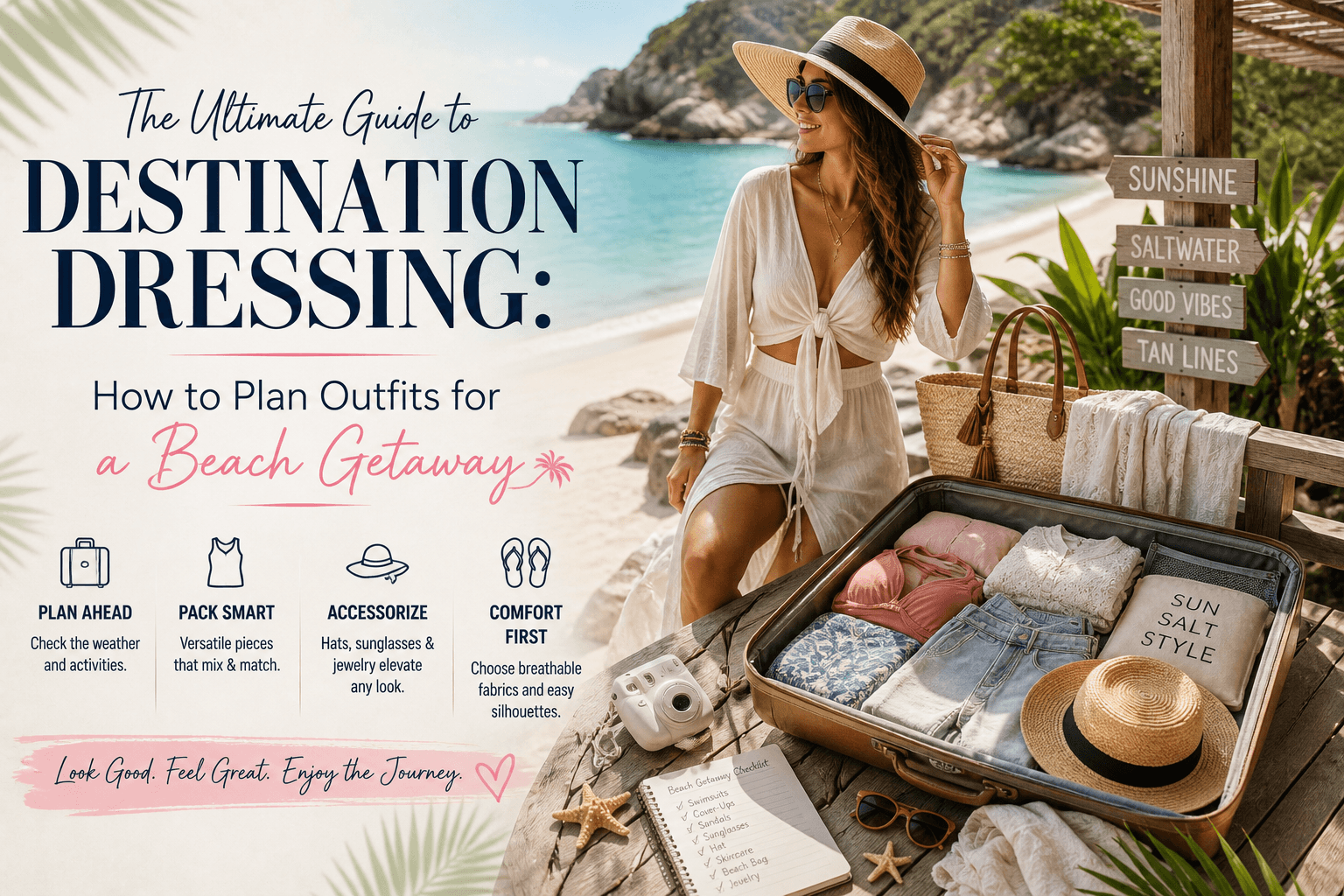
Many of us approach packing for a beach holiday as if we’re packing for life. The reality is, you return home with unworn outfits because you’ve been too busy leaping over waves and lounging by the pool to bother about sequins. The answer? Destination dressing. Plan your beach escape wardrobe around your vacation, not the other way around.
Why Most Beach Packing Lists Fail You
General advice when packing just says to take “a swimsuit, sunscreen, and something for dinner” which doesn’t help at all. According to a Hilton Hotels & Resorts travel survey, 64% of Americans confirm that they pack more than necessary for their travels, and more than 60% of travelers never use all the items they packed. That’s directly related to the fact that people tend to pack for situations that could happen, rather than for the things that will be happening.
When you go on a beach vacation, you’ll mostly spend your mornings at the beach, afternoons doing something fun or interesting, and your evenings having dinner somewhere where people are a bit more dressed up. If the things you’re bringing don’t suit this schedule, you’re going to end up wearing the same items over and over again and hauling other stuff back home.
Dressing for the destination and your itinerary means taking a look at those things before you start filling your suitcase. What kind of hotel are you staying at? Will you be going to the pool bar where they don’t allow wet swimming attire? Going snorkeling or on a waterfall hike? Or mostly just lying on the sand? Those are the things that will determine what you’re actually going to need to take with you.
The 3:2:1 Beach Capsule Formula
Here is a plan so you don’t have to take wild guesses: three swimsuits, plus two cover-ups, and one versatile dress that can take you straight from the pool to your dinner reservation.
Three swimsuits sound like a lot until you realize that you’ll be wearing each for the equivalent of two days. One for sunbathing and swimming, one that can handle movement (snorkeling, paddleboarding), and one “flashy” for that evening when you want your picture taken by the water at golden-hour.
You’ll be wearing each cover-up for the equivalent of one night and one day. One should be an elegant kaftan or long tunic that you can throw on and not feel like you’re doorman dodging, the other a casual sarong or wrap skirt that ties at the waist.
The version you’ll be wearing all night long is the dressy safety-dress that doubles up as a swimsuit cover-up but makes you look like you’re neither covering-up nor sloppy. It’s a cinch with your safety-dress, a shirt-dress or simple slip-over that looks great at lunch over your bathing clothes with a pair of sandals flipped over to the evening wedge.
Choose Swimwear That Serves Your Itinerary
Not every swimsuit suits every occasion. This is where we all go wrong with our packing. You browse the suits in a store, trying them on in a little square of weirdly lit mirrors, falling in love with that hot pink number that makes you look like a Malibu Barbie. You don’t stop to think about what you feel like after being in sand and saltwater for eight hours in a suit that looks like a tourniquet on your neck.
If you’re going to be out in the sun, prioritize suits that don’t leave tan lines that will make you wince in a few days. This is where the bandeau shines. Strapless styles don’t dig into sunburned shoulders the next day, don’t leave crossed strap lines that peek under the arm of your sundress at dinner, and they layer perfectly under a semi-sheer cover-up without any unwelcome peeks of hardware. Not to mention, a premium bandeau bikini top generally has underband support that provides far more stability than the average person imagines and doesn’t require incessant readjustments.
If you’re more active and there’s surfing, kayaking, or even just chasing the kids at the pool, that same bandeau’s not quite right unless it has sturdy boning or the option to add on straps. For those days, you’ll want something with solid, stable straps that don’t move, and preferably something without danger of beading or ruffles that hold a bucket of seawater against your chest.
Cover-Ups That Actually Earn Their Suitcase Space
A cover-up is not to be taken lightly, it’s the garment that turns your beachwear into something you feel comfortable wearing to lunch. The mistake is in packing units that only serve you in a very specific context.
A kaftan is your best bet because it goes over virtually any swimsuit style and looks “finished” when you leave the beach. Opt for one in a cotton or rayon blend that won’t stick to you with sweaty seaside skin.
A sarong is smaller and more packable than a kaftan, plus it serves a function the kaftan can’t: it can be tied into multiple shapes. Wrapped into a skirt for a beachside lunch, knotted into a strapless dress for a drink later, or simply draped loosely over your shoulders when the sun sets and the wind picks up.
The shirt-dress has to be mentioned here as its own separate entity, not part of your dress in a pinch capsule. A button front shirt-dress in a nice breathable fabric can be thrown over a bikini beachside, then unbuttoned a little and belted into something entirely new for dinner.
Building Outfits, Not Just Packing Items
Here’s a simple trick to build a small collection of mix-and-match clothes that gives you endless outfit options: Pack tops and bottoms separately (so you can grab one with your eyes half-closed), and mix bold with neutral.
If you bring four swim bottoms and four tops in coordinating but not identical colors, you can combine them into more outfits than you can count. Try it with your non-swim clothes: one pair of tomato-red shorts, for instance, and one tank in a similar but non-matching hue, will pair perfectly with your black bikini bottom and classic white top. Solid sandals add 33% more new outfits. Voila: three pieces. And only one of them had any flair.
This is the difference between a wardrobe and a pile of clothes. A wardrobe is a system where every piece has at least two potential outfit partners already in the bag.
Fabric Choices That Survive Sand, Sun, And Saltwater
Choosing the right type of clothing is more important when you go to the beach compared to other types of travel. This is because you have to consider humidity, saltwater, sunscreen, and sand.
When it comes to swimwear, opt for chlorine-resistant polyester-spandex or nylon fabrics. They will keep their shape and color much longer than cheaper fabrics. For other types of clothing, go for linen and rayon since they don’t wrinkle easily and recover quickly even if they’ve been packed for a while.
Bring a small wrinkle-release spray with you. It’s a tiny product that will help you with the problem of wrinkled clothes without needing an iron or steamer. Be prepared for stains. Sunscreen and sweat stains are inevitable during a beach trip. Clothes with dark or busy prints do a better job at hiding stains than solid-colored clothes. So, make sure to pack at least one darker outfit, even if the rest of your clothing is white or light-colored.
Footwear, Sorted By What You’re Actually Doing
One of the most common mistakes in packing for a beach trip is that everyone packs five pairs of shoes and wears two.
Sort your shoes by activity tier instead of by outfit. You need waterproof slide sandals for the beach itself, something with real cushioning for any walking excursions or town visits, and one foldable pair of wedges or heeled sandals that pack flat for dinner. That’s three pairs covering an entire trip, and each one has a clear job.
Skip the temptation to bring “just in case” shoes for a scenario that isn’t on your itinerary. If there’s no hiking planned, you don’t need hiking sandals. If you’re not going anywhere requiring real dress shoes, leave the heels at home and bring the packable wedges instead.
Don’t Waste Your Travel Day
The day you fly is a wasted wardrobe opportunity for most people, who show up in leggings and a hoodie and don’t put on real vacation clothes until day two. Build a travel outfit that doubles as beach-ready. A loose romper or breathable dress worn over a swimsuit means you can land, drop your bag, and walk straight to the water without changing.
Wear your bulkiest shoes and heaviest layer on the plane too, since those are the items hardest to pack efficiently and easiest to wear instead. The same goes for anything chunky or structured, like a denim jacket or a pair of sneakers, since it’s better on your body than squashed into your suitcase. It also frees up more room for the things that actually need the space, like your swimsuits and cover-ups.
The Lay-It-Out Test
Before you zip your suitcase, spread all the contents out in the form of full outfits on the bed. Sort it as a morning outfit, an afternoon outfit, an evening outfit, repeated for however many days you will be gone. This strategy will help you realize what you are overlooking or what you are overpacking more effectively than any list you have used in the past. If you cannot form a full outfit from the items spread out before you, you forgot to pack something. If you have five items packed that serve the same purpose, you need to leave one of them behind.
Destination dressing is not about encouraging you to go out and purchase additional resort wear. It is about being very deliberate while you pack your bag, ensuring that you use everything you brought with you and you didn’t overpack in the first place. Do the hard work once, then you will benefit from it on every future trip to the beach.