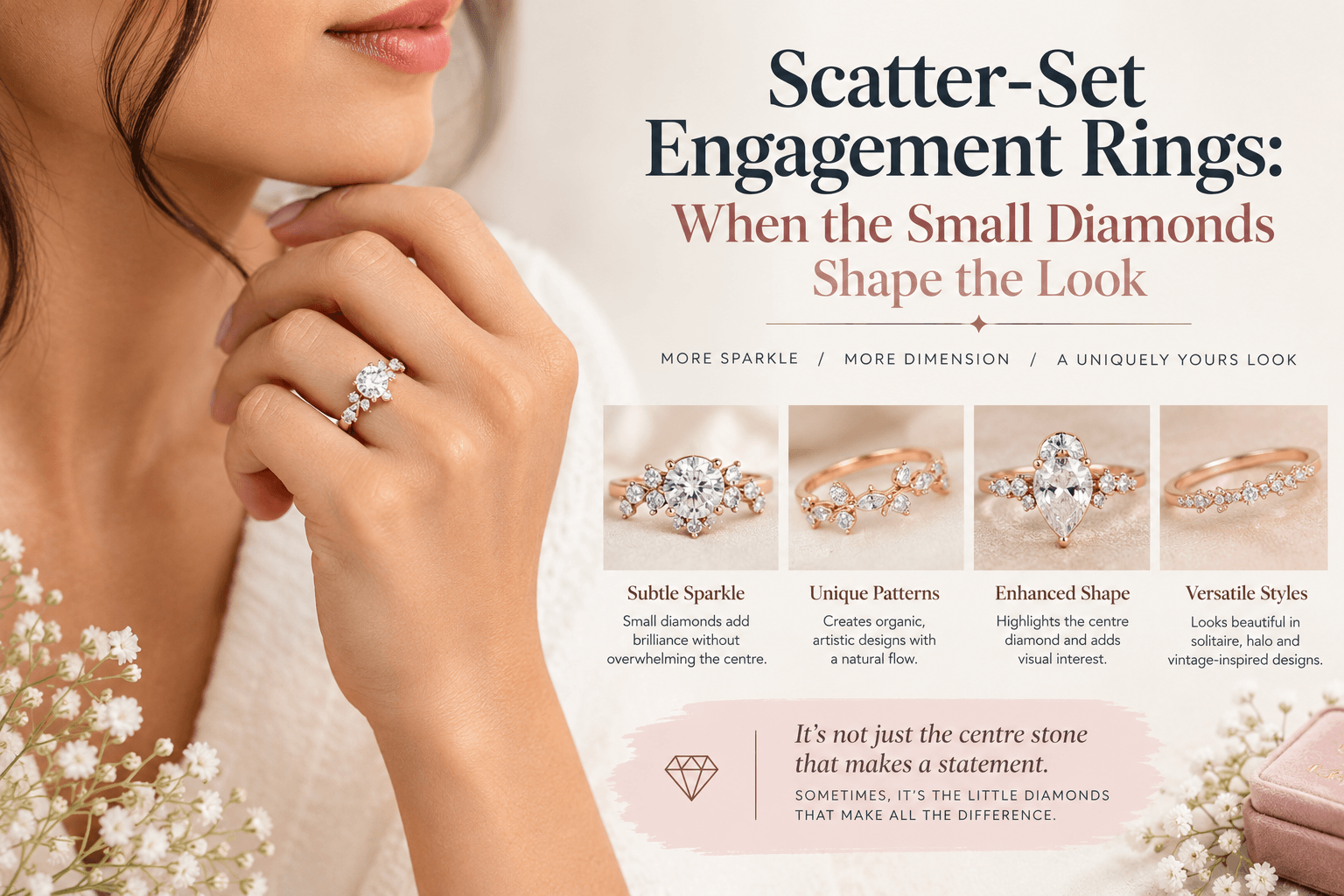
A row of tiny diamonds can give an engagement ring a neat, sparkling line. Scatter those stones at different angles, mix rounded shapes with pointed ones, and the outline becomes less uniform. Suddenly, the ring’s shoulders, the sections of band beside the centre setting, become part of what catches your eye.
That is the appeal of a scatter-set design. The smaller stones create a pattern of their own, rather than simply adding sparkle beside the centre diamond. To choose one well, look at how that pattern works across your hand, including the spaces between the stones.
What does scatter-set mean?
In this style, smaller stones are arranged in a varied pattern instead of a continuous, evenly spaced line. They might sit along the shoulders on either side of a larger centre, with different shapes or angles giving the edges a branching effect.
The name describes the arrangement, so it does not tell you everything about how the stones are held. Nor does it necessarily mean that the whole ring is asymmetric. Look at the actual design: a varied pattern on one shoulder may be repeated on the other.
Notice the shapes before counting the sparkle
Round diamonds create small, curved pauses in the pattern. Marquise shapes, with their elongated outlines and pointed ends, can suggest little leaves. Turn a marquise diagonally and it draws the eye in a different direction from one running along the band.
Among Lily Arkwright’s natural diamond ring styles, the round-centre Allure in 18ct white gold combines a natural diamond centre with round and marquise natural diamonds across the shoulders. It is a useful example of mixed shapes creating the detail around a clearly defined centre stone.
Decide which part you enjoy most. You might like a strong central diamond with a few smaller accents, or a design where the whole arrangement feels equally important. A larger centre can alter that balance, so check which centre size appears in the photographs you prefer.
The spaces are part of the design
A close-up helps you inspect the gaps between the stones and the metal supporting them. A whole-hand photograph shows how noticeable those details are during wear. Lighting can also affect how distinct the stones appear, so use both views to understand the pattern. Those gaps can be as distinctive as the diamonds themselves.
Compare the outer edges too. A compact arrangement keeps the detail close to the band; stones angled further out create a broader, more decorative outline. Ask for the width across the shoulder detail as well as the band width. A single measurement for the plain part cannot describe both.
Check the view from a slight angle, where the claws and supports become easier to see. You may prefer diamonds that look individually outlined, or a denser arrangement in which the small metal details are less noticeable.
Give the wedding band a place in the picture
If you intend to wear a wedding band beside the engagement ring, try them together while you are still choosing. The extra line of metal may sit neatly below the scatter pattern, leave a gap, or compete with the smaller stones along its edge.
A plain band can provide a simple border. A shaped band may follow the outline more closely, but check whether it leaves your favourite detail visible. Ask the jeweller to assess contact between the rings, rather than assuming that a close fit in a photograph means they will wear well together.
Choose detail you will enjoy wearing
During a fitting, let your fingers rest together and gently move your hand. Notice whether any part of the shoulder detail presses against a neighbouring finger. GIA’s guide to ring settings explains that raised prongs can catch on fabric and need occasional checks for security; ask how the particular design should be inspected and maintained.
There is a style question here too. The advice on building an accessory collection you actually use is a helpful starting point: consider the pieces you already reach for. A scatter-set ring may supply all the pattern you want beside a plain watch, while a sculptural bracelet might echo its changing outline. Try your familiar combination before adding anything new.
Finally, describe what attracts you without relying on the style name: “I like the little pointed stones and the open spaces, but I want the centre to remain the focus.” That gives you a much clearer starting point than asking for more sparkle.