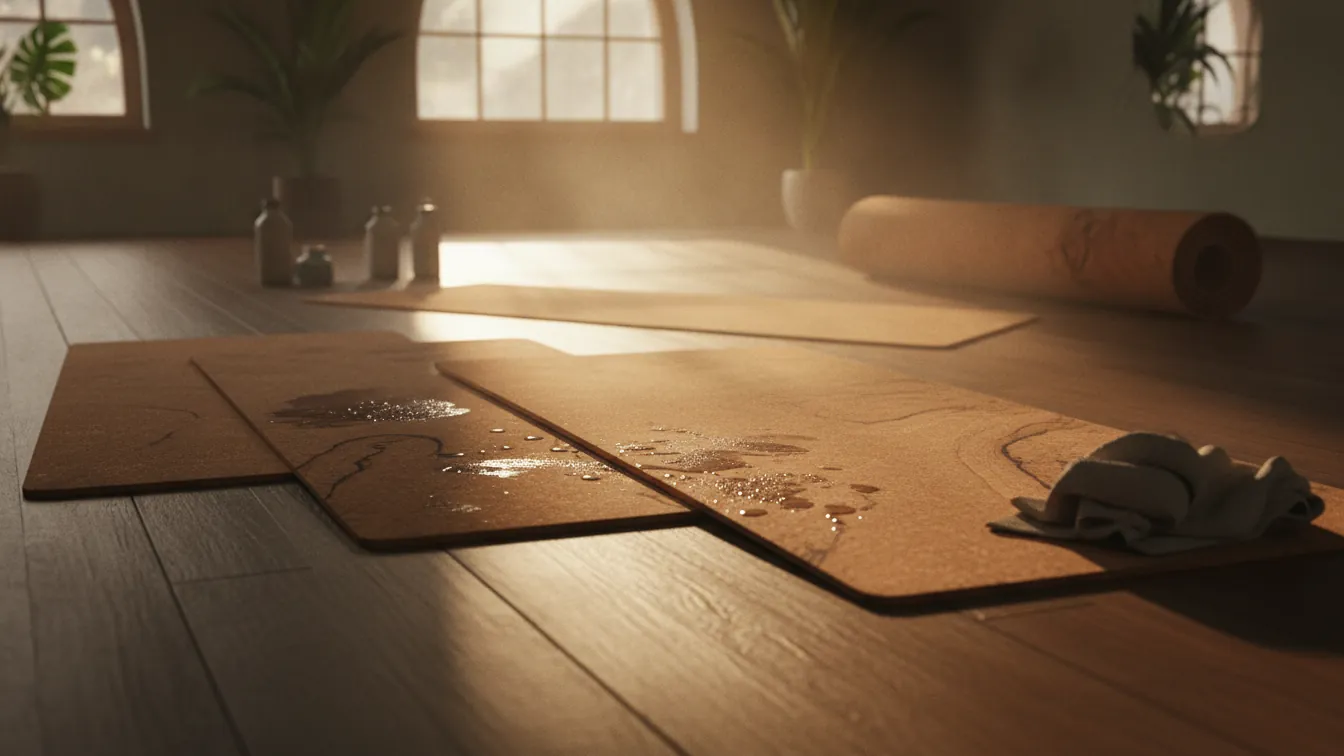
Anyone who has slid out of downward dog on a slick PVC mat mid-sun-salutation knows the problem: the harder you work, the less your mat seems to cooperate. Traction becomes especially important during hot yoga, heated vinyasa, or any sweaty practice, when a slipping hand can interrupt an otherwise steady flow. Cork offers a different feel under those conditions. Its natural texture can become grippier as moisture hits it, which helps explain why cork yoga mats appeal to practitioners who sweat through their sessions. Cork is also a renewable bark harvested without felling the tree, giving buyers a material choice worth considering alongside the mat’s backing and construction. As ( cork as a material) makes clear, the surface behaves differently underfoot than rubber, foam, or cork-laminate alternatives.
This guide ranks the five cork yoga mats most worth your money in 2026, with the emphasis on hot-yoga and heavy-sweat performance, cushioning, sustainability, and overall value for regular practice.
Our top pick is Gayo for practitioners who want a larger mat with built-in alignment guidance and cork-and-rubber cushioning. It pairs a bigger-than-standard footprint with printed alignment lines and a 5mm construction, giving beginners and taller practitioners a practical combination of room and support. For hot yoga specifically and buyers who sweat through every class, Goodplanet is the strongest alternative, thanks to its antimicrobial cork top and a wet-grip design built around sweaty practice. And if you’re shopping for someone who wants a cork mat with personality, or buying a gift rather than gear for yourself, Scoria World’s design-led, charity-backed mats are the better fit.
What ties all five picks together is their use of cork’s natural properties, with different approaches to backing, cushioning, and surface design. That matters for anyone evaluating sustainable yoga mat claims, since “eco-friendly” gets used loosely across this category, and a cork surface alone doesn’t tell you everything about the finished product. The rest of this guide breaks down how each mat is positioned, who it suits, and where its trade-offs lie, so you can match your choice to your actual practice rather than to marketing copy.
Cork Yoga Mats at a Glance
| Provider / Mat | Best For | Key Strength |
|---|---|---|
| Gayo | Alignment-focused and taller practitioners | 72 x 26-inch footprint, printed alignment lines, 5mm overall thickness |
| Tranquil Yogi | Dense support and placement guides | 72 x 24-inch cork-and-rubber mat with alignment markings and carrying strap |
| Goodplanet | Hot yoga and heavy sweaters | Moisture-responsive cork surface with lined or plain options |
| Ananday | Plant-based material priorities | Cork mat with plant-based brand positioning |
| Scoria World | Creative designs and gifting | Imaginative printed cork designs with a charitable giving model |
Our Selection Criteria
Ranking cork yoga mats fairly means weighing more than surface texture. The five practical criteria below help connect a mat’s construction and features to the demands of regular practice, including the compromises that become more noticeable when you carry it to class.
Cork Sourcing and Sustainability
Cork is inherently a renewable material, but “sustainable” and “eco-friendly” are used loosely across the yoga mat market. Cork-and-natural-rubber construction deserves attention alongside any synthetic layers, rather than treating the presence of cork as a complete environmental description. Specific claims also need specific meanings: 16 CFR 260.13 on recycled content claims addresses recycled content, which is a different claim from saying that a material is renewable.
Grip Performance Dry and Wet
Since this guide centers on hot yoga and sweaty practice, wet-condition grip matters more than dry-mat feel alone. A cork surface and rubber backing intended for sweaty use are relevant features, but the presence of cork by itself doesn’t tell you exactly how a mat will feel throughout your session.
Thickness and Cushioning
Many cork mats in this category sit around 5mm, which balances cushioning against ground connection. Density matters too: a firmer or plusher construction changes the feel beneath your knees and wrists, even when two mats have the same overall thickness.
Mat Dimensions and Portability
A mat’s footprint affects both comfort and convenience. Larger mats give taller or broader practitioners more room to move, but they’re bulkier to carry and store, so extra practice space comes with a practical trade-off between sessions.
Price-to-Quality Ratio
Cork mats span a wide price range. Construction, useful features, and durability should guide the comparison within that range, rather than an assumption that a higher price always means better value or a better fit for your practice.
The 5 Best Cork Yoga Mats for Hot Yoga and Sweaty Practice
With sourcing, grip, cushioning, dimensions, and value in mind, these five cork yoga mats offer options for slightly different kinds of practitioners in 2026. Gayo tops the list as the most well-rounded choice, while the remaining four have their own reasons to consider them, from dense support to a focus on sweaty sessions or gifting appeal. The differences become easier to judge once you look past the shared cork surface and consider how each mat fits into your usual routine.
#1. Gayo: Best for Alignment-Focused and Taller Practitioners
Gayo’s cork yoga mat earns the top spot by combining a larger-than-standard footprint with printed alignment lines and a cushioned 5mm construction. That combination is particularly useful if you want more space for wide stances without giving up visual placement references.
The mat measures roughly 72 x 26 inches, with 5mm overall thickness, and weighs about 9 lbs. Compared with a standard 68 x 24-inch yoga mat footprint, that gives taller or broader practitioners more room to move without edges cutting into hands or feet during wide-stance poses. The surface is built from sustainably sourced cork over a natural tree rubber base, with the rubber providing underside grip and cushioning while the cork supplies the textured practice surface. For shoppers comparing Sustainable Cork Yoga Mats, Gayo’s combination of size and guided alignment markings is its clearest point of differentiation. At $69.97, the question is whether those features suit your needs, especially if a smaller footprint or an unmarked surface would work just as well for you.
The printed alignment lines deserve a clear-eyed note: they’re reference cues for foot and hand placement, not a substitute for instruction or proprioception built through practice. Beginners and self-taught practitioners may find them useful for developing consistent positioning, but they’re guidance, not correction. Day-to-day care is straightforward: wipe the surface down with a damp cloth and mild soap, let it air dry completely, and roll it with the cork facing outward rather than inward, which helps the surface resist cracking over time. Like most cork mats, it’s best kept out of prolonged direct sun.
Key specs:
- Dimensions: approximately 72 x 26 inches, 5mm overall thickness
- Weight: approximately 9 lbs
- Materials: sustainably sourced cork top, natural tree rubber base
- Surface: printed alignment lines, non-slip cork texture
- Price: $69.97
Pros:
- Larger-than-standard footprint gives taller or broader practitioners more usable space
- Printed alignment lines help beginners develop consistent positioning
- 5mm cork-and-rubber construction provides cushioning and underside stability
- Cork-and-natural-rubber materials appeal to shoppers considering sustainability
- Textured cork surface suits practitioners looking for grip during sweaty practice
Cons:
- The larger size adds bulk, making it less convenient to carry to a studio or pack for travel than compact mats
- Alignment lines are a feature some minimalist practitioners simply don’t want on a clean surface
- Natural tree rubber backing is unsuitable for people who must avoid latex
Who it’s best for: Beginners who want built-in positioning guidance, and taller or broader practitioners who feel cramped on standard-size mats.
#2. Tranquil Yogi: Best for Dense Support and Placement Guides
Tranquil Yogi’s Tranquility Cork Yoga Mat combines natural cork with a dense natural rubber underside. The manufacturer describes medium traction on dry cork, with increasing grip as the mat becomes wet. That makes it an option for people moving between unheated classes and sweaty flows, rather than a mat reserved solely for hot yoga.
The listed dimensions are 72 x 24 inches, with 5mm overall thickness and a weight of 6.2 lbs. It is narrower and lighter than Gayo, although both have the same listed length and thickness. If you carry your mat frequently, that weight difference is worth considering alongside the space you need during wide stances and the feel you prefer beneath your hands.
This mat includes alignment markings and a carrying strap. The markings provide placement references, while the strap helps contain the mat on the way to class. Its dense construction favors a firm floor connection rather than deep foam softness, a distinction that matters even at the same thickness as another mat. People who prefer a very plush surface may still want a separate pad for extended kneeling.
Key specs:
- Dimensions: 72 x 24 inches
- Thickness: 5mm overall
- Weight: 6.2 lbs
- Materials: natural cork and natural rubber
- Extras: alignment system and carrying strap
Pros:
- Dense construction suits a firm practice surface
- Manufacturer describes increasing grip with moisture
- Alignment markings provide visual placement references
- Included strap supports carrying and storage
Cons:
- Its 24-inch width offers less lateral space than Gayo
- At 6.2 lbs, it still adds substantial weight to a studio bag
- Natural rubber is unsuitable for people who must avoid latex
Who it’s best for: Practitioners who want dense cork support and placement guides in a mat lighter than Gayo.
#3. Goodplanet: Best for Hot Yoga and Heavy Sweaters
Goodplanet’s Pro-Grip Cork & Natural Rubber Yoga Mat is built around the problem this guide opened with: maintaining traction as sweat increases. Its focus makes it especially relevant to buyers whose usual practice involves a heated room or sustained, sweaty movement.
The mat pairs a 100% natural antimicrobial cork top with a heavy-duty natural rubber backing, and the brand’s positioning is straightforward: it describes traction becoming more secure as you sweat. That emphasis will interest practitioners who regularly deal with damp hands during class, though a manufacturer’s moisture claim isn’t a comparison test against other mats. The antimicrobial description is a product feature, rather than a medical or hygiene guarantee. It’s available in two models, “With Line” for practitioners who want printed alignment markings and “Plain” for those who don’t, giving buyers a choice of surface layout within the same product line.
At 5mm, Goodplanet’s cushioning is described as “elite,” positioning it toward the more performance-oriented end of the category. The description is less useful than deciding whether that thickness and cork-and-rubber feel match the support you want during your own practice.
Key specs:
- Thickness: 5mm “elite” cushioning
- Surface: 100% natural antimicrobial cork top
- Backing: heavy-duty natural rubber
- Models: With Line, Plain
Pros:
- Antimicrobial cork top is part of the product’s construction and positioning
- Wet-grip design is intended for sweaty practice
- Heavy-duty rubber backing provides floor adhesion
- Choice between alignment-line and plain models suits different preferences
- 5mm cushioning balances support with ground connection
Cons:
- Built specifically for wet, sweaty conditions, which means gentle or restorative practitioners may not need this level of specialization
- The heavy-duty rubber backing adds noticeable weight compared to lighter travel-oriented mats
Who it’s best for: Hot yoga regulars and heavy sweaters who want a mat designed around wet-grip performance.
#4. Ananday: Best for Plant-Based Material Priorities
Ananday’s Cork Yoga Mat is listed at $118, and the brand places plant-based yoga gear at the center of its sustainability positioning. It is worth considering if material choices matter alongside the feel of a cork surface. Its appeal here is that material direction, not a claim that it outperforms the other mats in a heated room.
For a hot-yoga buyer, keep the distinction between a material preference and a performance guarantee clear. Cork can feel more secure with light moisture, but a comfortable practice still depends on your hand pressure, movement, and cleaning routine. Choosing a plant-based product does not remove the need to assess whether its surface suits your own practice, particularly if you’re used to a softer mat.
The price also creates a straightforward choice. At the listed figures, Ananday costs $48.03 more than Gayo. If your priorities are Gayo’s published dimensions and alignment lines, that difference may be hard to justify for your needs. If you prefer Ananday’s material positioning and brand, you may be comfortable with the higher upfront cost. Neither decision requires assuming that price predicts better wet grip, and both leave room for personal preference about how a mat feels.
Key details:
- Product: Ananday Cork Yoga Mat
- Listed price: $118
- Brand emphasis: plant-based yoga gear
Pros:
- A cork option for shoppers prioritizing plant-based materials
- Clear material-led sustainability positioning
- Published price makes the upfront cost easy to compare with Gayo
Cons:
- The listed price is higher than Gayo’s $69.97
- A cork surface differs from plush foam, which matters if softness is your main priority
Who it’s best for: Practitioners who prioritize plant-based materials and are comfortable with a higher purchase price than Gayo.
#5. Scoria World: Best for Creative Designs and Gifting
Scoria World takes a different approach to cork yoga mats, emphasizing imaginative, playful printed designs that most of the mats on this list don’t attempt. For a gift buyer or someone who wants their practice space to feel more personal, that visual difference can be a useful deciding factor.
The brand’s slip-resistant cork mats feature creative patterns described as designed “to spark the inner child,” making Scoria’s catalog visually distinct from the cleaner aesthetics of options such as Tranquil Yogi or Goodplanet. Scoria was born in Toronto, Canada, crowdfunded through Kickstarter, and is now headquartered in Oakville, Ontario, with a presence serving the United States market. Founded in 2016, it ties a charitable giving model to every purchase: a portion of proceeds goes toward feeding children in need, giving values-driven shoppers an additional reason to choose it beyond the mat itself.
Because design is central to the brand’s identity, buyers should decide how much that matters alongside their preferred surface feel and cushioning. A printed cork mat may be more appealing as a gift, while someone who likes a visually quiet practice space may prefer a plain alternative.
Key specs:
- Surface: slip-resistant cork
- Design: imaginative, creative printed patterns
- Founded: 2016, Kickstarter-crowdfunded
- Giving model: a portion of every purchase supports feeding children in need
- Headquarters: Oakville, Ontario, Canada, with US market presence
Pros:
- Distinctive printed designs set it apart visually from most cork mats
- Charitable giving component adds a values-driven reason to purchase
- Kickstarter crowdfunding origin reflects independent, community-backed roots
- Slip-resistant cork surface provides a textured practice surface
- Serves the US market despite being Canada-headquartered
Cons:
- Printed patterns may not appeal to practitioners who prefer a plain surface
- Its design-led appeal may matter less to buyers choosing primarily around cushioning and wet-grip preferences
Who it’s best for: Practitioners who want a cork mat with personality, or anyone buying a yoga mat as a gift.
Frequently Asked Questions
Do cork yoga mats get grippier when wet or sweaty?
Cork can feel tackier with moisture, which is one reason it appeals to people who practice in heated rooms. Brands like Goodplanet make sweat-related traction central to their product positioning. That doesn’t guarantee the same experience for every practitioner or establish superiority over every synthetic mat, but it does explain why cork is worth considering for hot yoga and other sweat-heavy practice styles.
How thick should a cork yoga mat be for joint support?
Many cork yoga mats in this roundup sit around 5mm. That thickness balances cushioning for knees, wrists, and hips against the stability you need for standing and balance poses. Thicker mats can feel plusher but may reduce ground connection during balance work, while thinner mats can feel firmer underfoot. Density and construction matter as much as the raw millimeter measurement, so thickness alone is an incomplete guide to comfort.
Are cork yoga mats better than PVC or TPE mats?
“Better” depends on what you’re optimizing for. Cork mats offer a natural surface with moisture-responsive grip and renewable material sourcing, while PVC and TPE mats can offer more cushioning options and lower price points. For hot yoga practitioners, the useful comparison is how the finished mat handles a sweaty session and whether its cushioning suits their practice, rather than assuming one material wins in every situation.
How do you clean and care for a cork yoga mat?
Most cork mats, including Gayo’s, have a straightforward care routine: wipe the surface with a damp cloth and mild soap after sweaty sessions, then let it air dry completely before rolling it away. Roll with the cork facing outward rather than inward to avoid creasing or cracking the surface over time. Keeping mats out of prolonged direct sunlight also helps preserve the material between sessions.
Are cork yoga mats worth the higher price?
For practitioners who sweat through practice regularly or care about renewable materials, cork can be worth the higher upfront cost. The value comes from choosing a surface and construction that suit repeated use, rather than paying more for the material name alone. For occasional or gentle practitioners who rarely sweat heavily, a less specialized mat may represent better value. Read environmental claims carefully as well: a renewable cork surface does not establish how the entire finished mat should be disposed of.
Are cork yoga mats safe for people with allergies?
The backing matters as much as the cork surface. Many cork mats use natural tree rubber, which is unsuitable for people who need to avoid latex. Read the complete material list, including backing and surface treatments, rather than assuming that “natural” means allergen-free. If you have a diagnosed allergy, ask your clinician about suitable materials before choosing a mat. Antimicrobial marketing also does not replace routine cleaning and drying.
Which cork yoga mat is best for beginners?
Gayo is the strongest pick for beginners because its printed alignment lines and larger footprint give new practitioners positioning references and extra room to find their form without feeling cramped. Those lines are a helpful reference, not a replacement for instruction, but they can make self-guided practice more approachable. The added size is most useful if a standard mat already feels restrictive during your usual poses.
The Bottom Line
Cork yoga mats have a clear appeal for sweaty practice: their textured surface can respond well to moisture, and renewable cork sourcing gives sustainability-minded practitioners a material worth considering. Across the five options here, the right choice still depends on your practice style and what you want to carry to class. Tranquil Yogi offers dense support with placement guides, Goodplanet focuses on wet-grip performance, Ananday emphasizes plant-based materials, and Scoria World brings printed designs and a charitable giving angle. For most practitioners, especially beginners and those who want both guided alignment and room to move, Gayo’s larger footprint and 5mm cork-and-rubber cushioning make it the most well-rounded place to start. Compare that extra space and its 9 lb weight with your usual practice setup before deciding whether it’s the right upgrade for your next sweaty session.