Facial hair removal can look simple until you start comparing the options.
Shaving is quick but temporary. Epilators remove hair from the root. IPL devices are widely used at home for progressive hair reduction, while professional laser treatments are designed to target suitable pigmented hair with more powerful light-based systems.
The best choice depends on more than convenience.
Hair color, hair thickness, skin sensitivity, treatment area, budget, pain tolerance, and how long you want the results to last can all change which method makes the most sense.
Quick Answer: Which Facial Hair Removal Method Is Best?
There is no single method that is best for everyone.
Shaving is usually the easiest option for quick, inexpensive hair removal.
Epilators can keep the skin smooth longer because they pull hairs from the root, but they can be uncomfortable, especially on sensitive facial areas.
IPL may be useful for people with suitable pigmented hair who want an at-home long-term reduction option.
Professional laser hair removal is generally better suited to people looking for more powerful treatment of larger amounts of dark, coarse facial hair.
Electrolysis can be worth considering when only a small number of hairs need treatment or when the hairs are blonde, gray, white, or otherwise poorly suited to light-based hair removal.
Why Facial Hair Removal Is Different
Facial hair is not always the same as body hair.
The face can contain a mixture of fine hairs, coarse terminal hairs, isolated chin hairs, upper-lip hair, sideburn hair, and lighter hairs that are difficult to treat with light-based technologies.
The skin may also be more sensitive than areas such as the legs or back.
This means that a method that works well on one body area may not automatically be the best choice for the face.
The first step is therefore to understand the type of hair you are trying to remove.
Shaving Facial Hair
Shaving is one of the simplest ways to remove facial hair.
It cuts hair at or near the skin surface without changing the follicle underneath.
The advantages are obvious:
- quick;
- inexpensive;
- easy to do at home;
- no need to wait for hair to grow long enough for removal;
- works on every hair color.
The main disadvantage is that results are temporary. Hair can become visible again relatively quickly because the follicle continues producing new growth.
Shaving also does not make hair permanently thicker or darker. The blunt end of a recently cut hair can sometimes feel coarser, but shaving does not change the underlying follicle into one that produces a fundamentally thicker hair.
Using an Epilator on Facial Hair
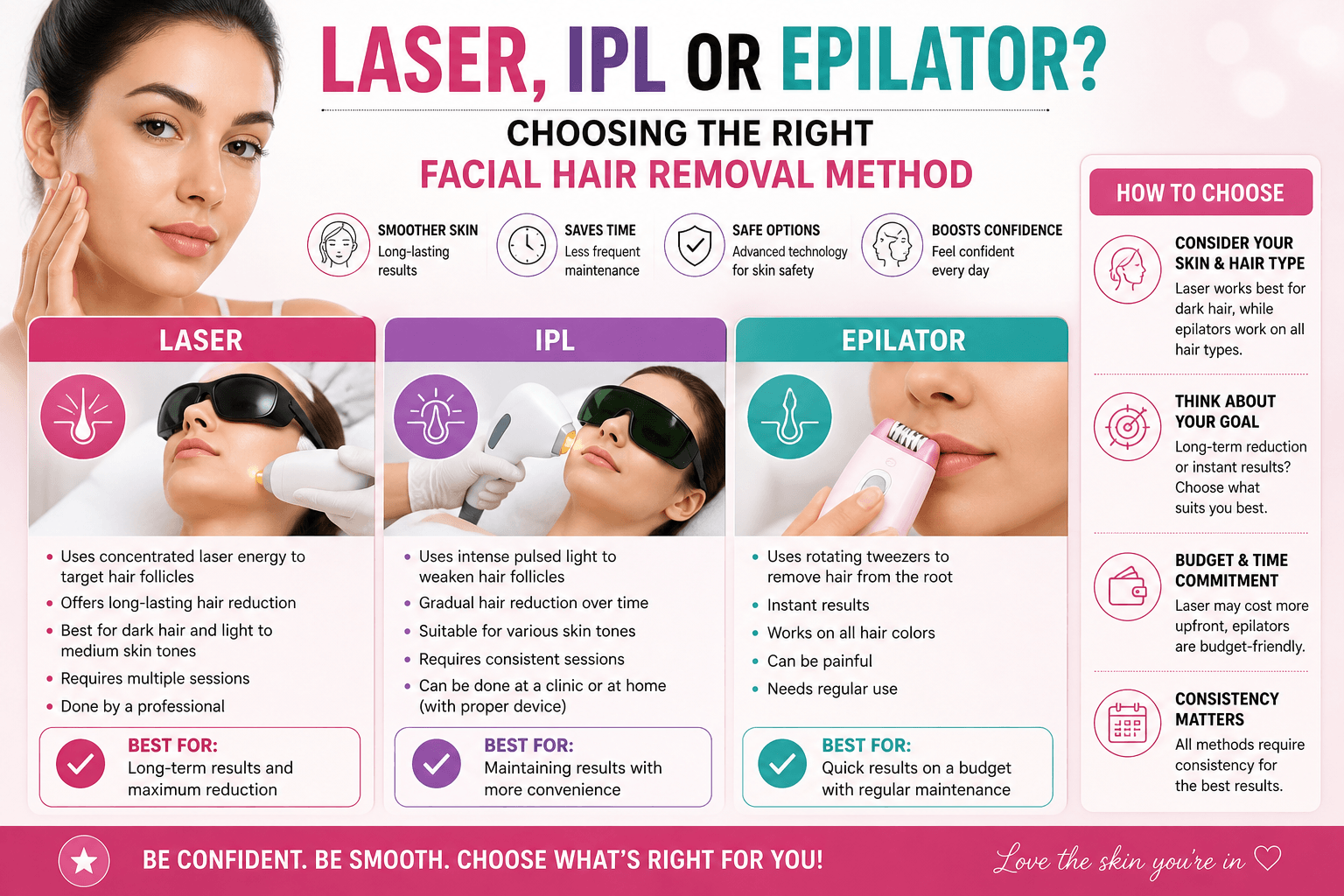
A facial epilator mechanically removes hairs from the root rather than cutting them at the surface.
That means the skin can remain smooth longer than it does after shaving because the hair needs time to grow back from below the surface.
Epilators can be useful for areas such as:
- chin;
- upper lip;
- jawline;
- sideburn area;
- small patches of unwanted facial hair.
Advantages of Facial Epilators
- Longer-lasting smoothness than shaving
- No need for light-based technology
- Works regardless of hair color
- Reusable device
- Convenient for home use
Disadvantages of Facial Epilators
- Can be uncomfortable
- May cause temporary redness
- Can contribute to irritation in sensitive skin
- Does not permanently stop the follicle from producing hair
- May be inconvenient for large areas of dense hair
An epilator therefore offers longer-lasting temporary removal rather than permanent hair reduction.
At-Home IPL for Facial Hair
IPL stands for intense pulsed light.
At-home IPL devices use broad-spectrum light intended to target pigmented hair and progressively reduce regrowth over repeated treatments.
IPL is not technically the same as a laser, although both rely on the interaction between light energy and pigment.
Because pigment is important, IPL tends to work best when the unwanted hair is noticeably darker than the surrounding skin.
Who May Be a Good Candidate for At-Home IPL?
At-home IPL may be worth considering when:
- the unwanted hair is dark enough to provide a useful light target;
- the skin and hair combination is compatible with the device;
- the user is willing to follow a repeated treatment schedule;
- the treatment area is approved for use by the device manufacturer.
When IPL May Be Less Useful
IPL becomes less practical as hair pigment decreases.
Very light blonde, gray, and white hairs may not provide enough pigment for effective light-based targeting.
People with sensitive skin should also follow device instructions carefully and avoid using a consumer device on areas not approved by the manufacturer.
Professional Laser Hair Removal for the Face
Professional laser hair removal uses concentrated laser light to target suitable pigmented hair.
Compared with at-home devices, professional systems can offer greater control over treatment parameters and are operated by trained professionals.
Laser treatment is generally most useful when facial hair is:
- dark;
- coarse;
- present in larger numbers;
- suitable for light-based targeting.
Common facial treatment areas can include:
- upper lip;
- chin;
- jawline;
- sideburns;
- selected neck areas.
For someone with many coarse dark chin hairs, professional laser treatment may be more practical than mechanically removing each hair at home.
Laser vs IPL for Facial Hair
Laser and IPL are often grouped together, but they are not identical technologies.
Laser systems use specific wavelengths of light. IPL produces a broader spectrum that is filtered for the intended application.
For consumers, the more important difference is often where and how the treatment is performed.
| Feature | Professional Laser | At-Home IPL |
|---|---|---|
| Treatment environment | Professional clinic | Home use |
| Energy and settings | Professional equipment with adjustable treatment parameters | Designed for consumer self-use |
| Convenience | Requires appointments | Can be used at home |
| Hair pigment requirement | Important | Important |
| Blonde, gray, white hair | Often poor targets | Often poor targets |
| Long-term goal | Professional hair reduction | Progressive at-home hair reduction |
What About Electrolysis?
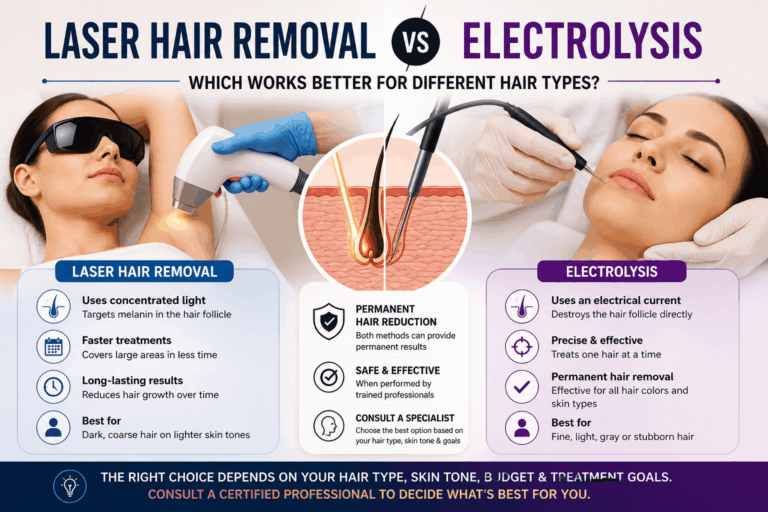
Electrolysis is another option for facial hair removal and is especially relevant when the hair does not respond well to pigment-dependent light treatments.
The method treats individual follicles rather than exposing an area to light.
Electrolysis can be particularly useful for:
- white chin hairs;
- gray facial hairs;
- very light blonde hairs;
- isolated persistent hairs;
- small areas where follicle-by-follicle treatment is practical.
The main drawback is time. Treating individual follicles is usually less practical when thousands of hairs need treatment across a larger area.
Which Facial Hair Removal Method Lasts the Longest?
The answer depends on what “lasting” means.
Shaving provides temporary surface removal.
Epilators remove hairs from the root, so smoothness usually lasts longer than shaving.
IPL and laser are designed to progressively reduce future visible hair growth rather than simply removing the current hair shaft.
Electrolysis works on individual follicles and is generally considered when permanent treatment of specific hairs is the goal.
The most useful comparison is therefore not simply which method gives the smoothest skin the day after treatment, but how the follicle behaves over time.
Which Method Is Best for Dark Facial Hair?
Dark, coarse facial hair generally provides a stronger target for laser and IPL than very light hair.
For larger numbers of dark terminal hairs, professional laser treatment can be attractive because it can address many hairs across a treatment area.
At-home IPL may be suitable for some users who prefer convenience and whose skin and hair characteristics are compatible with the device.
Epilators and shaving still work regardless of pigment, but they provide temporary removal rather than long-term light-based reduction.
Which Method Is Best for Blonde Facial Hair?
Blonde facial hair can be more difficult for laser and IPL because the amount of pigment available for optical targeting is reduced.
Darker blonde hair may behave differently from pale blonde hair, so individual suitability varies.
For very light blonde hairs, options such as epilation or electrolysis may make more sense than repeated light-based treatment.
Which Method Is Best for Gray or White Facial Hair?
Gray and especially white hairs contain little or no useful pigment for conventional laser or IPL targeting.
That makes shaving, epilation, and electrolysis more relevant options.
For a small number of persistent white chin hairs, electrolysis may be particularly practical because individual follicles can be treated directly.
What Is Best for Sensitive Skin?
Sensitive skin does not automatically make one method universally best.
Each approach can produce different temporary skin reactions.
Shaving may cause razor irritation. Epilation can cause redness and tenderness. Depilatory products may irritate reactive skin. IPL and laser can also produce temporary redness or sensitivity.
People with sensitive skin should consider:
- how their skin reacts to previous hair-removal methods;
- whether the product is approved for the intended facial area;
- whether patch testing is appropriate;
- whether professional assessment is needed;
- how much irritation they are willing to tolerate for longer-lasting results.
Which Facial Hair Removal Method Hurts the Least?
Pain and discomfort are highly individual.
Shaving is usually among the least painful methods when performed carefully.
Epilators can be more uncomfortable because multiple hairs are pulled from the root.
Laser and IPL may feel warm, snapping, or stinging during light delivery.
Electrolysis involves repeated treatment of individual follicles and can also produce localized discomfort.
The face contains sensitive areas, so the upper lip, chin, jawline, and neck may feel different even with the same treatment method.
How Much Time Do You Want to Spend on Hair Removal?
Convenience is one of the biggest differences between facial hair removal methods.
| Method | Time Commitment | Maintenance |
|---|---|---|
| Shaving | Very quick | Frequent |
| Epilator | Moderate | Repeated as hair regrows |
| At-Home IPL | Repeated home sessions | May include ongoing maintenance |
| Professional Laser | Clinic appointments across a treatment course | Maintenance may sometimes be needed |
| Electrolysis | Can be time-consuming because follicles are treated individually | Depends on number of remaining hairs |
How to Choose the Right Facial Hair Removal Method
There is no reason to choose a method based only on which technology sounds the most advanced.
A better approach is to consider the actual hair and the result you want.
Start With Hair Color
Dark, pigmented hair is generally better suited to laser and IPL.
Blonde, gray, and white hairs may favor electrolysis or temporary removal methods.
Consider Hair Thickness
Coarse terminal hair is different from fine facial hair.
A method that works well on thick chin hair may not be appropriate for fine hairs across the cheeks.
Consider How Much Hair You Have
Professional laser becomes more practical when many suitable hairs need treatment.
Electrolysis becomes more practical when only a limited number of individual hairs remain.
Decide Whether You Want Temporary Removal or Long-Term Reduction
If convenience today matters most, shaving or epilation may be enough.
If the goal is progressive long-term reduction, IPL or professional laser may be more appropriate for suitable hair.
If the goal is individual treatment of very light or isolated hairs, electrolysis deserves consideration.
Facial Hair Removal Methods Compared
Choosing among different facial hair removal methods is easier when hair color, density, skin characteristics, convenience, and the desired duration of results are considered together rather than separately.
| Method | Best For | Main Limitation |
|---|---|---|
| Shaving | Quick, inexpensive temporary removal | Hair returns quickly |
| Facial Epilator | Longer-lasting temporary root removal | Can be uncomfortable and irritating |
| At-Home IPL | Convenient progressive reduction of suitable pigmented hair | Limited by hair and skin characteristics |
| Professional Laser | Large numbers of dark, coarse facial hairs | Poor target when hair contains little pigment |
| Electrolysis | Individual hairs, including blonde, gray, and white hairs | Slow for large numbers of hairs |
Common Facial Hair Removal Mistakes
Assuming the Most Expensive Method Is Automatically Best
The correct method depends on the hair and treatment goal, not simply the treatment price.
Using Light-Based Devices on Unsuitable Hair
Very lightly pigmented hair may not provide a useful target for laser or IPL, regardless of how expensive the device is.
Ignoring Facial Skin Sensitivity
The face can react differently from the legs or body. A product or treatment that works well elsewhere should not automatically be used on the face without checking whether the area is appropriate.
Expecting One Session to Create Permanent Results
Light-based hair reduction generally develops through repeated treatments rather than one appointment.
Choosing a Method Without Considering How Many Hairs Need Treatment
Treating five white chin hairs is completely different from reducing hundreds of coarse dark hairs. The number of hairs can be just as important as their color.
Final Takeaway: Laser, IPL or Epilator?
The best facial hair removal method depends on what kind of hair you have and what you want from treatment.
Shaving is the simplest choice for fast temporary removal.
Epilators can provide longer-lasting smoothness without relying on hair pigment, but they can be uncomfortable.
At-home IPL can be convenient for people with suitable pigmented hair who are willing to follow a repeated treatment schedule.
Professional laser hair removal is generally more practical for larger amounts of dark, coarse facial hair.
Electrolysis is especially useful for isolated or lightly pigmented hairs that conventional laser and IPL may struggle to target.
There is therefore no need to search for one universally “best” device or treatment.
The better decision comes from matching the method to your hair color, hair thickness, number of hairs, skin characteristics, pain tolerance, budget, and desired duration of results.