Permanent hair removal is a phrase used everywhere, from clinic advertisements to at-home beauty devices. But not every method that removes visible hair produces the same kind of long-term result.
Shaving can make skin feel smooth for a day or two. Waxing and epilation remove hair from the root and can keep an area hair-free for longer. Laser and IPL are designed to reduce future hair growth over repeated treatments, while electrolysis works directly on individual follicles.
The important question is therefore not simply, “Which method removes hair?”
It is: Which methods can meaningfully reduce or stop future hair growth, and which only remove the hair that is currently visible?
Quick Answer: What Is the Best Method for Long-Term Hair Removal?
There is no single permanent hair removal method that is ideal for every person.
Laser hair removal is often the most practical option for reducing large areas of dark, pigmented hair because multiple hairs can be treated across a relatively large area.
Electrolysis is especially useful when individual follicles need to be treated or when the unwanted hairs are blonde, gray, white, or otherwise poorly suited to pigment-dependent laser treatment.
IPL can also reduce unwanted hair over time, particularly when the hair and skin characteristics are appropriate, although IPL is not technically the same as a laser.
Methods such as shaving, waxing, epilators, and depilatory creams can be effective for temporary hair removal, but they do not permanently stop follicles from producing hair.
What Does “Permanent Hair Removal” Actually Mean?
The word “permanent” can be confusing because different technologies aim for different treatment outcomes.
Some approaches are designed primarily to remove the hair that is currently visible. Others are intended to reduce the ability of follicles to continue producing hair.
This distinction matters because smooth skin immediately after treatment does not necessarily tell you anything about what will happen several months later.
A useful way to think about hair removal is to divide methods into three categories:
- surface hair removal;
- root-level temporary removal;
- long-term follicle-targeting treatments.
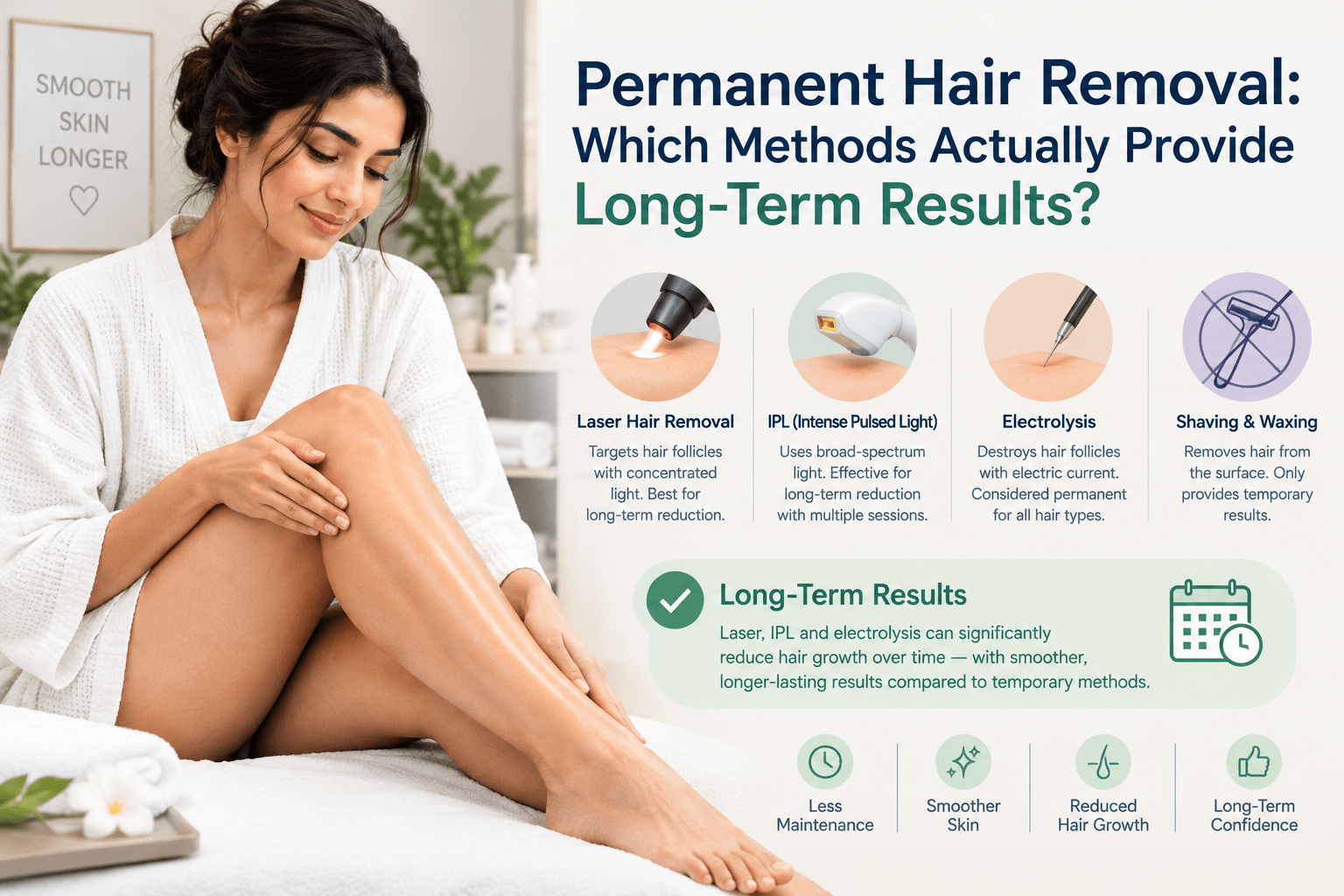
Temporary vs Long-Term Hair Removal Methods
| Method | What It Does | Typical Goal |
|---|---|---|
| Shaving | Cuts hair at the skin surface | Temporary smoothness |
| Depilatory Cream | Dissolves visible hair near the skin surface | Temporary hair removal |
| Waxing | Pulls hair out from the root | Longer-lasting temporary removal |
| Epilator | Mechanically removes multiple hairs from the root | Longer-lasting temporary removal |
| IPL | Uses broad-spectrum light to target pigmented hair | Progressive hair reduction |
| Laser Hair Removal | Uses laser light to target suitable pigmented hair | Long-term hair reduction |
| Electrolysis | Treats individual follicles with electrical energy | Permanent treatment of individual follicles |
Laser Hair Removal
Laser hair removal is one of the most widely known long-term hair reduction methods.
The treatment uses concentrated light energy that is absorbed by pigment associated with the hair. The absorbed energy is converted into heat and used to affect structures involved in future hair growth.
Because pigment is central to this process, hair color has a major influence on treatment suitability.
Who Is Laser Hair Removal Best Suited For?
Laser hair removal is generally most practical when there is a substantial amount of dark, coarse, pigmented hair.
Common treatment areas include:
- legs;
- underarms;
- bikini area;
- back;
- chest;
- arms; and
- selected facial areas.
Its major practical advantage is treatment speed. A laser can cover an area containing many hairs rather than requiring every follicle to be treated individually.
What Are the Limitations of Laser Hair Removal?
Laser hair removal is not equally suitable for every hair color.
Very light blonde, gray, and white hairs contain little pigment for conventional hair-removal lasers to target. Red hair can also be more difficult depending on the amount and type of pigment present.
Skin characteristics also matter because pigment exists in both the hair and surrounding skin. Appropriate technology, treatment settings, cooling, and professional assessment are therefore important.
Laser hair removal should also be understood as a course of treatment rather than a one-session solution. Hair follicles do not all behave identically at the same time, so multiple sessions are commonly used to achieve progressive reduction.
Electrolysis
Electrolysis works very differently from laser hair removal.
Instead of exposing an area of hair to light, electrolysis treats follicles individually. A fine probe is introduced into the follicle opening and electrical energy is delivered to affect the structures responsible for continued hair growth.
The biggest advantage of this approach is that it does not require the hair to contain substantial pigment.
Which Hair Types Are Best Suited to Electrolysis?
Electrolysis can be particularly useful for:
- blonde hairs;
- gray hairs;
- white hairs;
- some red hairs;
- isolated facial hairs;
- small treatment areas; and
- individual hairs remaining after other hair-reduction treatments.
This makes electrolysis an important option when hair does not provide a strong optical target for laser or IPL.
What Are the Limitations of Electrolysis?
The main limitation is time.
Because follicles are treated individually, electrolysis can become a substantial commitment when thousands of hairs need to be removed.
Treating a handful of white chin hairs is fundamentally different from trying to clear both full legs with follicle-by-follicle treatment.
This is one reason the size of the treatment area matters so much when comparing permanent hair removal options.
IPL Hair Removal
IPL stands for intense pulsed light.
Although IPL is often casually described as “IPL laser hair removal,” it is not technically a laser. Instead of producing one specific laser wavelength, IPL devices emit a broader spectrum of light that is filtered for the intended treatment.
Like laser hair removal, IPL depends heavily on pigment within the hair.
This means it generally performs better when there is enough contrast between the unwanted hair and surrounding skin.
Professional IPL vs At-Home IPL
IPL exists in both professional and consumer-device formats.
Professional systems are designed for trained operators and may allow greater control over treatment parameters. Consumer IPL devices are designed around lower-energy, self-administered treatments and emphasize convenience.
The two should not automatically be treated as equivalent simply because both use intense pulsed light.
Is IPL Permanent?
IPL is better understood as a long-term hair reduction method rather than a guarantee that every treated follicle will permanently stop producing hair.
Repeated treatment can progressively reduce visible growth when the hair and skin are appropriate for light-based targeting.
Maintenance treatments may also be part of some users’ long-term routines.
Waxing: Effective but Temporary
Waxing removes hair from the root, which allows the skin to remain smooth longer than it does after shaving.
However, removing the hair shaft from the follicle is not the same as permanently disabling the follicle.
New hair can grow again as the follicle continues through future growth cycles.
Waxing is therefore useful for people who want several weeks of smoother skin without committing to an energy-based treatment, but it should not be considered permanent hair removal.
Epilators: Root Removal Without Long-Term Follicle Reduction
An epilator mechanically grasps multiple hairs and pulls them from the root.
This can produce longer-lasting smoothness than shaving because the hair must grow again from below the skin surface.
However, epilation does not intentionally disable the follicle responsible for future growth.
It is therefore a temporary hair-removal method, even when repeated epilation makes regrowth appear finer or less noticeable for some users.
Depilatory Creams
Depilatory creams chemically break down visible hair so it can be wiped away from the skin.
They can be convenient and painless for some users, but the effect is temporary because the follicle remains capable of producing new hair.
Sensitivity and irritation can also occur, so products should be used according to their instructions and tested appropriately before broader application.
Shaving
Shaving remains one of the simplest and most affordable ways to remove unwanted hair.
It cuts the hair at or near the skin surface without changing the follicle underneath.
Hair can therefore become visible again relatively quickly.
Shaving also does not make hair permanently thicker. The blunt end of a recently shaved hair can sometimes feel coarser as it grows, but shaving itself does not transform the follicle into one that produces a fundamentally thicker hair.
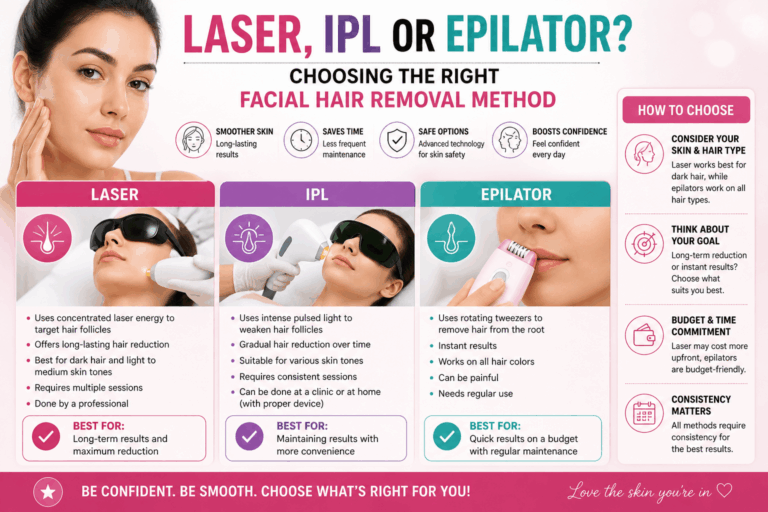
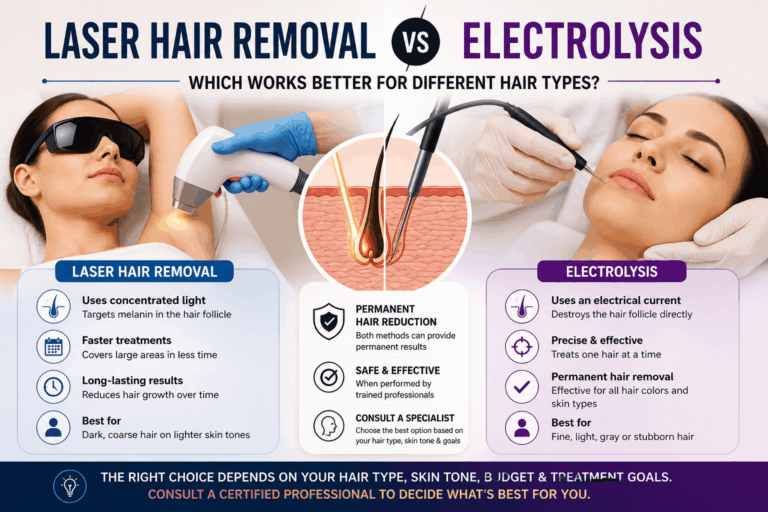
Laser vs Electrolysis vs IPL
The most useful way to compare permanent hair removal methods is to separate technologies by how they interact with the follicle, which hair types they can target, and how practical they are for the size of the treatment area.
| Comparison | Laser Hair Removal | IPL | Electrolysis |
|---|---|---|---|
| Treatment mechanism | Laser light targets suitable pigmented hair | Broad-spectrum light targets suitable pigmented hair | Electrical energy treats individual follicles |
| Best suited hair | Generally dark, coarse, pigmented hair | Generally pigmented hair with appropriate skin contrast | Any hair color can be treated individually |
| Blonde hair | Often difficult | Often difficult | Can be treated |
| Gray hair | Poor optical target | Poor optical target | Can be treated |
| White hair | Generally unsuitable for conventional targeting | Generally unsuitable for conventional targeting | Can be treated |
| Large areas | Efficient | Efficient when appropriate | Time-consuming |
| Individual hairs | Less precise for isolated hairs | Less precise for isolated hairs | Highly targeted |
| Typical goal | Long-term hair reduction | Long-term hair reduction | Permanent treatment of individual follicles |
Which Permanent Hair Removal Method Works Best for Dark Hair?
Dark, coarse hair is generally where laser hair removal has its strongest practical advantage.
The pigment provides a useful optical target, while laser systems can treat large areas much faster than follicle-by-follicle electrolysis.
IPL may also be suitable for pigmented hair when the surrounding skin and treatment parameters are appropriate.
Electrolysis can treat dark hair as well, but its individual-follicle approach may make it less practical when tens of thousands of hairs need treatment.
Which Method Works for Blonde Hair?
Blonde hair varies considerably.
Darker blonde hair may contain more pigment than very pale blonde hair, but conventional laser and IPL become less reliable as the optical target becomes weaker.
Electrolysis does not depend on that pigmentation, so it may be more appropriate for very lightly colored hairs.
Which Method Works for Gray and White Hair?
Gray and especially white hairs contain little or no melanin available for conventional light-based hair removal.
That makes electrolysis particularly relevant.
Changing laser wavelength does not replace pigment that is absent from the hair. Consumers should therefore be cautious about claims suggesting that every conventional laser system can permanently remove fully white hair.
Which Method Is Better for Large Areas?
Treatment-area size can completely change the practical decision.
For large areas containing suitable dark hair, laser or professional light-based treatment can be much more efficient because many follicles can be treated during the same session.
Examples include:
- legs;
- back;
- chest;
- arms;
- underarms; and
- bikini area.
Using electrolysis alone for a very large, densely haired area can require substantially more treatment time.
Which Method Is Better for a Few Individual Hairs?
The answer can reverse when only a few hairs need treatment.
If someone has a small number of white hairs on the chin, the large-area efficiency of laser treatment provides little benefit, while the lack of pigment creates an optical limitation.
Electrolysis can instead treat each follicle directly.
This makes the number of hairs just as important as their color.
Can Hair Grow Back After Laser or IPL?
Yes. Hair can remain, return, or become noticeable again after light-based hair reduction.
This does not necessarily mean the treatment had no effect.
Laser and IPL are generally intended to produce a long-term decrease in the amount, density, and visibility of hair. They should not automatically be interpreted as a guarantee that every follicle in the area will stop producing hair forever.
Future growth can be influenced by factors such as:
- hair-growth cycles;
- treatment response;
- treatment area;
- hormonal influences;
- age;
- remaining untreated follicles; and
- maintenance schedule.
Can Hair Grow Back After Electrolysis?
Electrolysis is intended to permanently treat individual follicles, but the treatment process still involves multiple visits because not every visible or potential hair can necessarily be completed in one session.
New hairs becoming visible later do not always mean a previously treated follicle has recovered. Hair-growth cycles and previously inactive follicles can affect what appears in the treatment area over time.
This is particularly relevant for people with facial hair influenced by ongoing hormonal factors.
Can You Combine Hair Removal Methods?
Yes. Hair removal does not always have to be an either-or decision.
Someone with a mixture of dark and white hair may benefit from discussing different approaches for each hair population.
For example:
- laser may be used to reduce larger quantities of suitable dark hair;
- electrolysis may later address isolated white or gray hairs;
- shaving may be used between treatment sessions when appropriate; and
- maintenance treatments may be considered according to future growth.
The best combination depends on the person’s hair, skin, treatment history, and goals.
How to Choose a Long-Term Hair Removal Method
The right choice should begin with the characteristics of the hair and treatment area, not with the marketing name of a device.
Consider Hair Color
Dark, pigmented hair is generally more suitable for laser and IPL.
Blonde, gray, and white hairs may be more appropriate for electrolysis.
Consider Hair Thickness
Coarse terminal hair generally provides a stronger target for light-based treatment than extremely fine hair.
Consider the Size of the Treatment Area
Large areas can favor laser or IPL because many hairs can be treated efficiently.
Small numbers of individual hairs can favor electrolysis.
Consider Your Skin Characteristics
Skin pigmentation can influence which light-based technology and treatment parameters are appropriate.
Professional assessment is therefore important when choosing laser or IPL treatment.
Consider the Result You Actually Want
Someone who wants to reduce dense leg hair has a different treatment goal from someone trying to permanently remove ten white facial hairs.
The word “permanent” alone does not identify the most practical method.
Consider Time and Convenience
Laser and IPL can treat many hairs relatively quickly, while electrolysis requires individual follicle treatment.
For some people, the time commitment is as important as treatment cost.
Common Mistakes When Choosing Permanent Hair Removal
Assuming Every Method Is Truly Permanent
Shaving, waxing, epilation, and depilatory creams remove existing hair but do not permanently disable the follicles responsible for future growth.
Assuming Every Hair Color Can Be Treated With Laser
Laser hair removal depends strongly on pigment. Fully white hair does not provide the same optical target as coarse black hair.
Choosing by Price Alone
A cheap single treatment does not necessarily mean a lower total cost.
The number of sessions, treatment area, amount of hair, maintenance requirements, and time commitment all matter.
Expecting One Session to Solve Everything
Long-term hair reduction generally develops through a treatment course rather than one isolated appointment.
Ignoring the Cause of New Hair Growth
Hair growth can be influenced by biology and hormonal factors. A treatment can affect existing follicles without preventing every previously inactive follicle from producing new hair in the future.
Final Takeaway: Which Permanent Hair Removal Method Is Best?
There is no single best permanent hair removal method for every hair type, skin type, and treatment area.
Laser hair removal is generally one of the most practical options for reducing large areas of dark, coarse, pigmented hair.
Electrolysis is especially important for individual follicles and hairs that do not provide a suitable pigment target, including blonde, gray, and white hair.
IPL can provide progressive hair reduction for appropriate users but should not be confused with a laser or assumed to work equally well for every hair and skin combination.
Temporary methods such as shaving, waxing, epilation, and depilatory creams remain useful when convenience, cost, or short-term smoothness matters more than long-term follicle reduction.
The most useful decision therefore starts with four questions:
- What color and thickness is the unwanted hair?
- How large is the treatment area?
- What are the surrounding skin characteristics?
- Is the goal temporary smoothness, long-term reduction, or individual follicle removal?
Once those questions are answered, choosing between laser, IPL, electrolysis, and temporary hair-removal methods becomes much more straightforward.