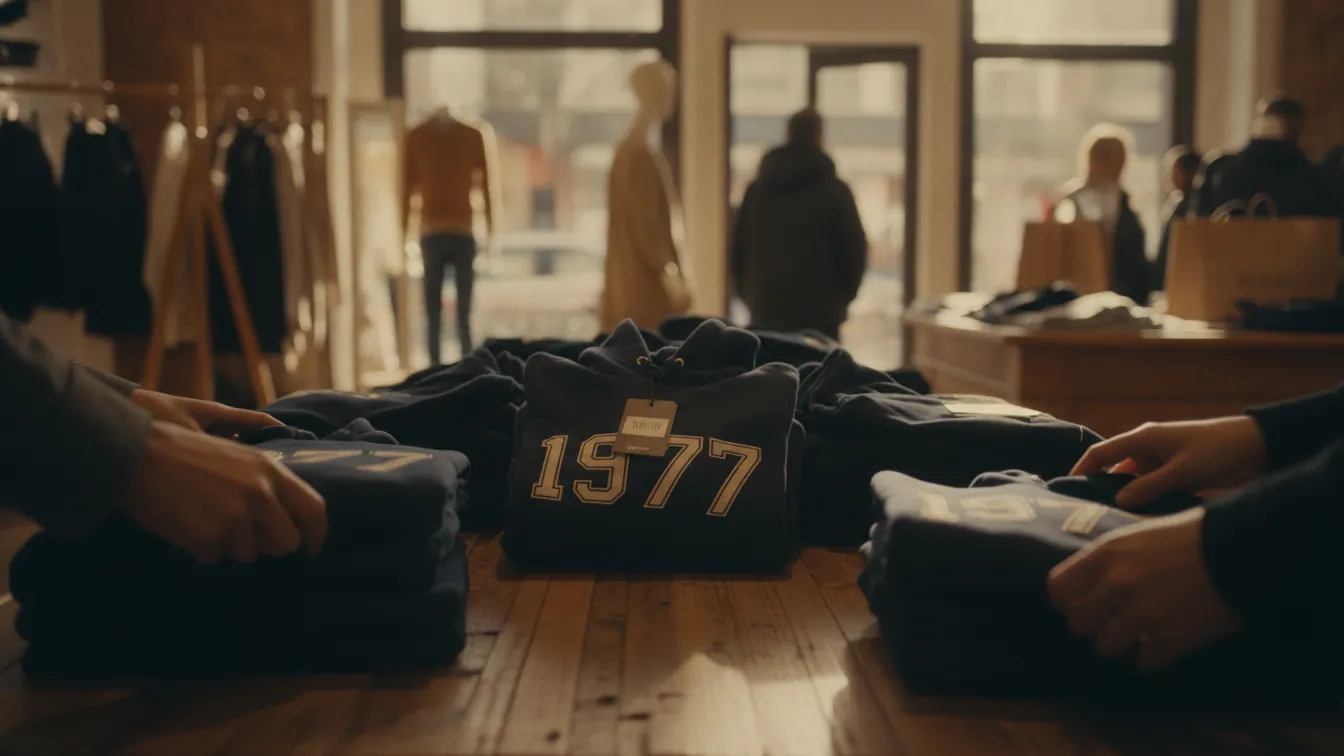
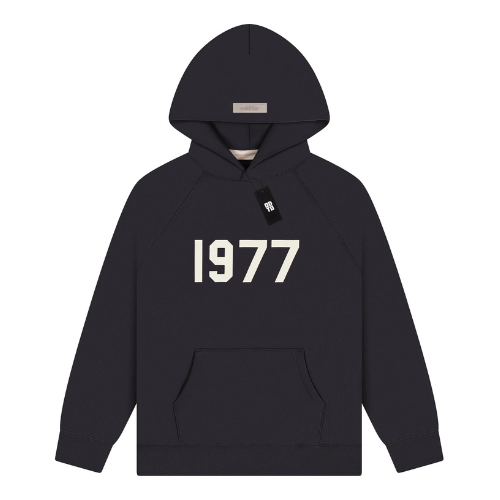
Open the 1977 category on a Tuesday afternoon and the pattern is hard to miss. Small, available. Large, available. Medium, crossed out — and it’s usually been crossed out since the weekend. There are fourteen pieces sitting in that category at Essentials Clothing, which isn’t a deep shelf to start with, and the middle of the size run is where the thinning always begins.
Which isn’t bad luck, and it isn’t the store hiding inventory from you either. It’s arithmetic, mostly, plus one quirk in how a boxy hoodie gets bought.
Medium ends up serving shoppers from three sizes
The cut here is wide through the body with the shoulder seam dropped well down the arm, so it hangs rather than follows you. That changes who reaches for what. Somebody who wears a small in a slim tee still wants the roomy silhouette they saw in the photo, so they skip their own size and take a medium. Meanwhile a genuine large reads “runs oversized” in half a dozen places, pictures himself swimming in fabric, and sizes down — to a medium. And then, of course, the actual mediums buy mediums.
Three groups, one bin. That’s basically the whole explanation.
Sneakers in a men’s 9 do the same thing. The middle of any range gets picked over first, because it’s where the undecided default to — and a short lineup feels that harder, since there’s nothing underneath to soak up the overflow.
Fourteen listings is a short lineup, not a warehouse
Context helps here. The t-shirt category runs about thirty items and the tracksuits sit around twenty-two, so the 1977 shelf is the shortest of the three — fourteen, and one of those is the kids’ version. Each of those listings still has to carry a full size run.
Do that division and the per-size, per-color count gets thin fast. The store says outright that stock moves and that a color may never be restocked, which is more honest than most shops bother with, so take it literally. A medium in Wheat isn’t one of a thousand units in a bin somewhere. It’s one slot on a short list.
The size run tells you where the drop is in its life
This is the part I’d actually use, because it costs you nothing. Before you fall for a color, look at which sizes are still live across the 1977 Essentials Hoodie listings rather than staring at one product page in isolation.
If nearly everything is selectable across most colors, you’re early and can take your time. If the mediums and larges have gone quiet while the extremes are still clickable, you’re at the tail end of a run and the shoppers have already taken what fit them. One color with a full set of sizes while the rest are patchy just means it’s less popular — excellent news if it’s the one you wanted anyway.
Check two or three listings, not one. A single page can look healthy by accident.
Unisex sizing pushes more people toward the middle
The store lists these as unisex, and the women’s section carries the same designs as the men’s rather than separate patterns cut to different blocks. Practically speaking that means everybody is choosing from one set of labels, so a woman who wants the oversized look lands on a small or a medium, a man of average build lands on a medium or a large, and the overlap — again — is the medium.
It’s not a flaw. A boxy garment is the one place unisex honestly works, since there’s enough room through the chest and hip that the pattern needn’t commit to one body. But it concentrates demand, and that shows up on the category page a few days into a drop.
Say your size is already gone
Then you’ve got three moves, and only one of them is any good.
Waiting on a restock is the weakest, for the reason above. Buying the wrong size planning to swap it later is worse — an exchange only works if the size is sitting there, and the size sitting there is the one you couldn’t get in the first place. That’s a circle you don’t want to stand in holding a hoodie you can’t wear.
What works is measuring first and deciding in advance which neighboring size you’d accept. Lay a hoodie you already like flat, measure pit to pit, compare that against the listing instead of guessing from a photo. One size up reads as a longer, slouchier version of the same thing; one size down takes the drop out of the shoulder. If a size down is all that’s left, I’d take it, provided your flat number is within an inch or so.
Timing, including the bit people forget
Stock isn’t the only clock running. Orders sit in processing for one to three days, Monday through Friday, and the standard service is $15 across an eight to twelve business day window — which, once a weekend lands in the middle, is two real weeks. So deciding Thursday night that you want a heavy hoodie for next week’s cold snap isn’t a plan. Paying $40 for express shortens the transit, not the queue in front of it.
Read the terms too, because they’re tighter than a department store’s. No cash refunds — a swap or store credit within thirty days, unworn, tags on. Big drops and holiday weeks run slower than usual, which is exactly when everybody orders.
Frequently Asked Questions
Will Medium come back in stock?
Sometimes, and nobody can tell you which times. The store’s own wording warns that a color won’t always be restocked, and fourteen listings leaves little room to bring things back. Darker, plainer colors reappear more often than odd ones. That’s a tendency, not a promise.
Should I just take the Small if the Medium has gone?
Measure before you answer. A small on this cut still sits wide next to an ordinary hoodie, so plenty of people are happy there — you lose a bit of shoulder drop and length. If your flat measurement runs more than an inch over it, watch a different color instead.
Does paying for faster shipping help me beat a sellout?
No. The stock is either there or gone at the moment you check out, and faster service only moves the parcel once it’s packed. Processing still takes its one to three days either way.
Pick a color you’ll still want in March, write your pit-to-pit number down somewhere you can find it, and look at the category when a drop is fresh instead of three weeks in. Mediums go first because mediums are everybody’s compromise. Knowing that is most of the advantage you need.