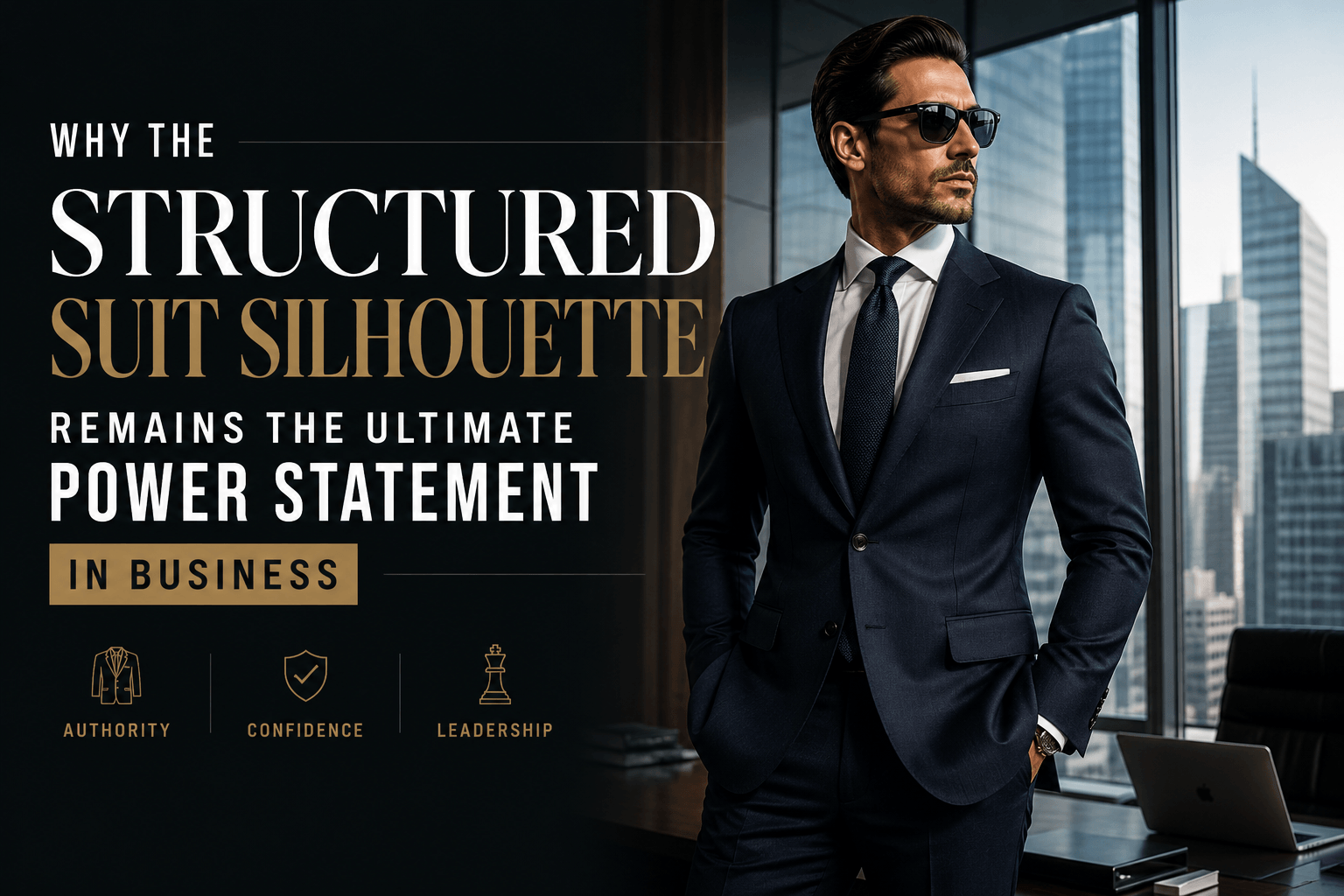
Wearing a structured suit doesn’t only make you look authoritative – it impacts the mindset of the person wearing it. Researchers in 2015 from California State University, Northridge, and Columbia University found in the journal _Social Psychological and Personality Science_ that formal, structured clothing notably increases abstract cognitive processing while also raising the wearer’s self-perceived sense of power. That’s the type of high-level, strategic thinking that can make a difference in important meetings, rather than the tactical, focused decisions you might need to make while studying a spreadsheet in your hoodie.
According to researchers, that’s what they describe as enclothed cognition – the concept that clothing actually influences cognitive and emotional states rather than just reflecting them. When you put on a jacket featuring a structured chest, roped shoulder, and a fitted waist, your posture changes, you breathe differently, and your overall demeanor shifts. You’re not simply attired for the meeting. You’ve physically readied yourself for it. That’s not a tiny psychological advantage. If your career is important to you, it’s worth taking the time to understand what’s actually creating this effect, and the reasons why the structured suit silhouette in particular brings it out.
What Makes A Jacket Structured – and Why It Matters
Most individuals may be aware of the distinction between a structured and unstructured jacket, although they might not be able to define it. Details matter because the individual components have a specific function.
First things first, a full-canvas construction is essentially the internal skeleton of a proper suit jacket. It’s a layer of horsehair and wool that is stitched (not glued) to the outer shell. Running from the shoulder through the chest of the jacket, this layer of canvas sits between the shell and the lining. Over time, the canvas will gradually begin to shape to the wearer’s body. On the other hand, a fused jacket will noticeably deteriorate over time. This type of jacket uses interlining that is bonded by heat, starting off rigid, it eventually begins to bubble, peel, and lose its natural shape. While canvas ages gracefully, fused does not.
The chest piece is the dense part that you find at the breast, comprising canvas, haircloth, and light padding. This prevents the lapels from sagging and maintains a clean chest profile, even under the heaviest use. If absent, a jacket that was flat in the morning will inevitably look like a sack of potatoes by noon.
The roped shoulder is the main distinguishing feature of a British structured jacket (or any structured jacket, for that matter). The sleevehead shifts slightly above the shoulder line, creating a subtle raised ridge. Seen from afar, this effect causes the shoulder to appear broader and squarer. In a military setting, this was intended to make troops look more intimidating. In the office, it’s meant to telegraph presence and poise.
High armholes are a relatively subtle component of a structured jacket. Most people don’t notice them, however, they are pretty important. They allow for your arm to move freely without pulling around the padded shoulder. Cheap suits with low armholes greatly restrict this movement, causing them to pull in the back. A well-fitted structured jacket should move with you, not against you.
The V-Taper and The Geometry Of Authority
For centuries, if you needed to fake physical presence and strength, a tailor was the required technician. Tailoring methods are consistent because the physical proportions of an imposing, vigorous human haven’t changed either.
The curvature of the shoulder creates width. Vertical narrowing is equally important. This comes down to waist suppression: the alteration where a skilled pair of hands hems in your jacket at the sides to hug the natural curve of your waist. It is a classic V-taper silhouette. With shoulders straightened, waist suppressed, a jacket implies, visually, the kind of physical proportion that for millennia communicated brute strength and vitality to our species. It doesn’t matter what the wearer’s actual build is. Good structure and fit impose those proportions optically.
The double-breasted takes these principles to their greatest, most overtly psychological lengths. Six buttons, four buttons, wide-button stance, peak lapel, broader chest panel – more than any single-breasted equivalent, a double-breasted jacket commands visual heft. This is the garment you select when the message you are sending isn’t “I appear to be the leader”, or even “I should be considered as the leader”, but simply “I am the leader”.
The perhaps more esoteric contributor to shoulder width is the lapel roll. A lapel’s roll is something you can’t discern in a photograph, any more than you can sense the heft of a steering wheel in a video game. It is a detailing that is best considered hands-on and is another of the items that separate a hand-canvased suit from a fused one. A lapel, given space to roll, curves three-dimensionally like a wave away from the chest rather than lying flat. This contributes to the depth of the chest silhouette. A chest with a hearty middle looks inhabited rather than deflated.
The construction tradition that refined all of these details into a consistent, repeatable craft was established in London. The hand-canvased construction and historic shoulder profiles of Savile Row suits represent the benchmark that modern tailors globally still measure themselves against – including those producing structured suits at more accessible price points.
Military Origins Of Corporate Armor
The structured suit didn’t have its origins in an office. It was battlefield all the way.
19th-century military uniform design had very practical goals: make the wearer look as imposing as possible, project his rank as far as the eye can see, and maintain a disciplined, consistent silhouette over a variety of extraordinarily physical movements. Padded shoulders created the impression of physical breadth. Structured chests held medals and absorbed the visual weight of rank insignia. The roped sleevehead – that ridge at the shoulder – was originally engineered to prevent a heavy epaulette from deforming the shoulder line.
When tailors started co-opting all these uniform principles for everyday non-killing-a-guy purposes, they co-opted the authority connotations too. The suit was the uniform of the merchant class, then the professional class, then the executive class. Whatever looked like discipline when draped over a general’s shoulders looked like command when thrown over a banker’s. The fundamental visual language was the same.
So that’s why a structured suit reads as authoritative even to people who couldn’t tell you the first thing about tailoring. The signal is old. We’ve been reading it for a long time.
Fabric Selection and Structural Integrity
The shape of the suit holds up only if the fabric cooperates. Worsted wool’s high twist keeps the wrinkle away and the crease clean. A lightweight worsted suit can take you from the first meeting in the morning to the last cocktail in another city across a week’s worth of work without looking like you slept in it. The smooth surface of the fabric does excellent showroom duty too, holding up those tailoring lines – shoulder seam, chest roll, waist – exactly right.
For a heavily structured jacket, weight is needed in the cloth as well. Anything below 9oz lacks that natural heft required to keep the canvas in its place and the shoulder holding its shape. The best range for a true working business suit is 11oz to 13oz: enough to give you a proper drape to the body but not too much to suffer deformation under a coat or the weight of a long day.
A heavier cloth like flannel works beautifully for the same reasons. The slight texture it brings in adds a nice subliminal layer of interest without detracting from the clean lines of the silhouette, and it ages gorgeously with the kind of movement only possible with a canvased jacket.
Lightweight linens and silk blends will kill the illusion in a structured jacket. The fabric can’t support the architecture. The suit ends up fighting itself.
The Contrarian Advantage In A Casualized Office
The shift toward casual office dress didn’t start recently, but it accelerated sharply over the past decade. Tech company culture exported its dress codes – hoodies, sneakers, quarter-zips – into industries that had no particular reason to adopt them. The result is a professional environment where most rooms have leveled down to a visual baseline that communicates almost nothing distinctive about any individual in it.
This is where the structured suit stopped being a conformist choice and became a deliberate one.
Neapolitan tailoring – the unstructured, soft-shouldered, shirt-like Italian alternative – blends into this casualized environment easily. A British structured jacket with roped shoulders and a defined chest does not. It contrasts. In a room of zip-vests and business casual, a person wearing a properly fitted, fully structured suit doesn’t just look different – they look decided. They made a choice where others made an accommodation.
That’s corporate casualization working in reverse. The suit used to signal conformity to a universal professional norm. Now it signals something harder to ignore: that the person wearing it shows up differently, on purpose.
This isn’t nostalgia for a stricter dress code. It’s an active use of men’s fashion as a personal branding tool. The logic is simple – if everyone around you has abandoned the structured suit, wearing one costs you nothing socially and gains you a significant amount of visual distinction. The room reads it before you’ve said a word.
Wearing A Structured Suit In The Current Decade
A heavily structured jacket doesn’t look good if it looks like it’s wearing you.
The easiest way to let the jacket dominate is to overdo everything else. If you’re in a structured suit, everything else should be slimmer and more minimal. That’s not a rule limited to your tailoring, but as good a general guideline as any for modern dressing.
Cutting in on trousers: remember how a jacket generally reads a man as stronger and more competent by sloping his shoulder line down? You do not want that looking like an optical illusion because the trousers go straight from hip down in a boxy, old-mannish line. With structured jackets, it’s usually best to stick to a straight-leg or slightly tapered trouser – suit trousers are a bad place to experiment with wide-legged volume – that works with, not against, the broad rectangular shape boxy jackets push you towards on top.
Lapel width: very unhelpfully, the optimal lapel widths are directly proportionate to shoulder width. If you’re in the kind of actively structured suit jacket we’re talking about, though, opt for something between 3 and 3.5 inches. Both peak lapels in the 2.75 inch range and notches in the 4 inch range read really visually period. The whole 70s shaggy dog thing doesn’t fly with structured suiting – you’re not looking to mine costume-y vintage here.
Shoes: if everything’s neat from chest to ankle and you mess this up with a poor shoe choice, the structured suit’s out again. A plain-toe oxford or a decent loafer don’t compete with what’s happening on top because there are no excessive details, just the sharp low-profile lines you need to complete the clean, businesslike silhouette.
Shirt collar: easily overlooked, but it matters. Especially with structured jackets, the wider spread collar naturally occupies that little shirt-visible-below-the-tie you get with a suit and tie. A short, stubby little point collar always looks a bit weedy coupled with a jacket that’s chucking out its chest and squaring its shoulders.
The structured suit isn’t new. It was big in the 1980s, which was when the objectives around it first became clear. Here’s why it’s getting a second wind: it’s impossible to read as anything other than consciously, visibly powerful within the current decade. The actual reasons to wear one – sensible comfort, increased authority, implicitly signalling that you’re on the level – haven’t changed.