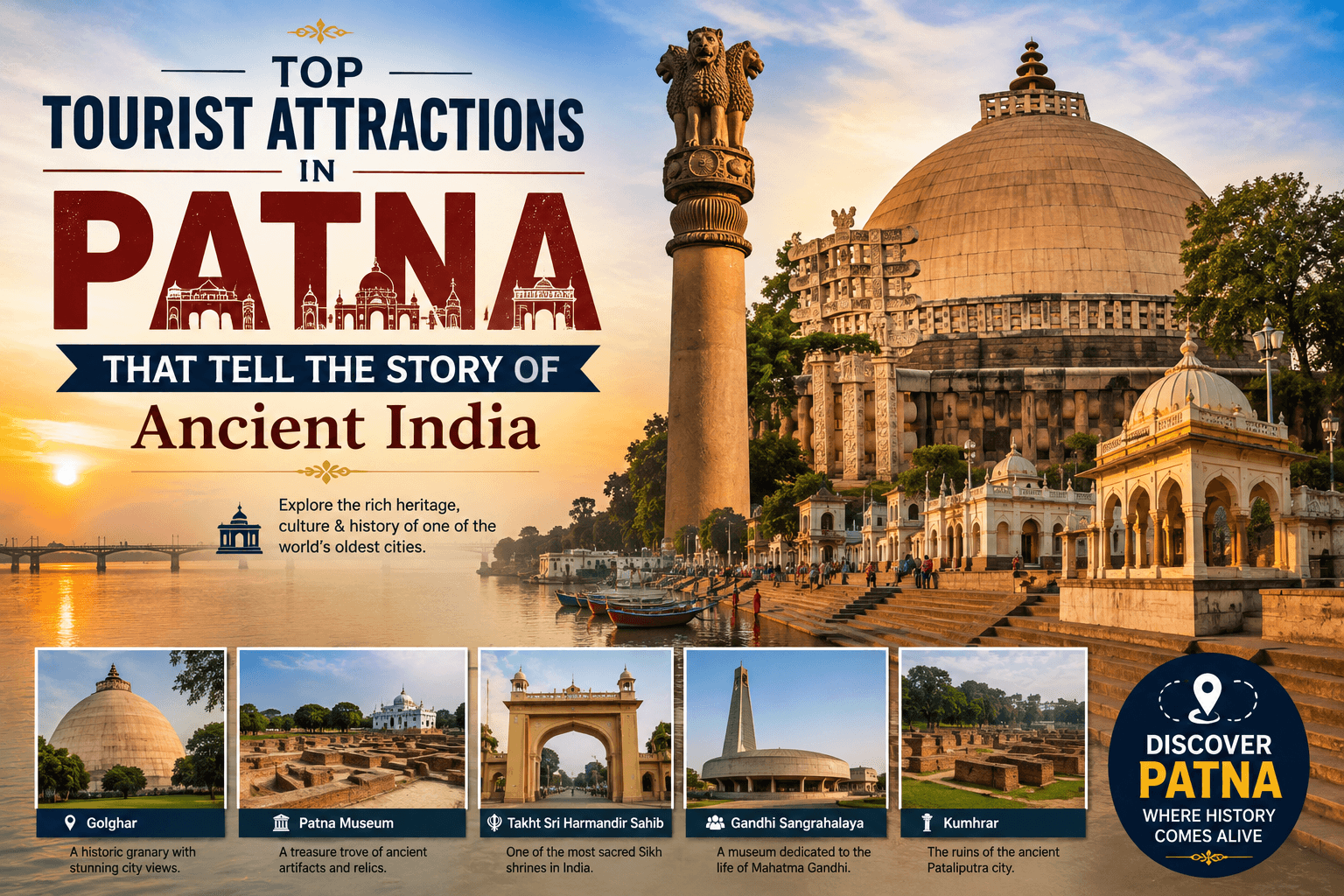
Patna is much more than the capital city of the state of Bihar. This city is among the oldest continuously inhabited cities in the world with many stories of its glorious past hidden within its streets, monuments, and religious places. The city was formerly called Pataliputra and had once been the capital of famous empires such as the Maurya and Gupta, thus becoming a political, cultural, educational, and religious centre. Travellers today can get a glimpse of this glorious history from its monuments and heritage. Visiting the top tourist spots in Patna helps one understand the development of ancient India to become the greatest civilisation in the world.
Golghar – A Colonial Landmark with Historical Importance
Golghar is an exception to other historical sites since it belongs to the British era instead of ancient India, but it is still one of the most well-known structures in Patna. Constructed in 1786 as a place for keeping grain during a famine.
The visitors have an opportunity to go up by stairs and see the view from above of the city and the Ganges. Golghar gives a good start to understanding the history of the city since it is connected to both periods.
Kumhrar – The Remains of Ancient Pataliputra
The trip to Patna would not be complete without taking time to explore Kumhrar, one of the greatest archaeological places within the city. Excavations at the place have unearthed ruins of the old city of Pataliputra, especially the eighty-pillared hall that is said to be from the Maurya era.
The walk around Kumhrar gives an amazing insight into the administrative prowess of one of the earliest Indian empires. Informational exhibits reveal the history of a city which used to attract scholars, diplomats, and merchants from around the world.
Agam Kuan – A Well Surrounded by Mystery
Agam Kuan translates to mean “Unfathomable Well” and it is linked with the reign of Emperor Ashoka. It continues to be a very fascinating historic site located in Patna.
According to history scholars, the well could have been there during the time of the Mauryans while according to popular belief in the area, it witnessed some incredible events that took place during the initial years of Ashoka’s rule.
Patna Museum – Preserving the Region’s Rich Heritage
For those who wish to know about the history of Bihar, Patna Museum is a must-visit.
The museum possesses sculptures of the Mauryan and Gupta eras, ancient coins, manuscripts, terracotta objects, and Buddhist objects. Some of the most famous possessions include the fossilised tree which is believed to have existed millions of years ago. This makes the collections an interesting source of information regarding ancient Indian arts and culture.
Takht Sri Patna Sahib – A Sacred Sikh Pilgrimage
Although Patna has a strong connection to the history of India, it is also possesses immense significance in Sikhism.
The place Takht Sri Patna Sahib was where the tenth Guru of Sikhs, Guru Gobind Singh was born. This grand shrine draws tourists from all around the world as it is an architectural marvel and also houses relics of historical significance.
It proves the centuries-old tradition of Patna being a multi-cultural and multi-religious city.
Bihar Museum – Connecting Ancient and Modern India
The Bihar Museum offers a modern view of history. With its modern galleries and exhibitions, it is a good complement to the Patna Museum that focuses on the artefacts of the ancient civilizations of Bihar.
People will have the opportunity to visit galleries with sculptures, archaeology, tribal history, and other themes dating back thousands of years. The exhibition is highly interesting for family vacations and young tourists.
Gandhi Ghat – History Along the Ganges
Gandhi Ghat, situated along the River Ganges, provides a serene location and also highlights the association of Patna with the river which has been responsible for shaping the civilization of northern India.
The evening Ganga Aarti is performed for both the locals as well as visitors and a spiritual ambiance is created by chanting and singing. Although there is no direct connection between the ghat and ancient India, it is an example of how important the Ganges river has always been to the area.
Khuda Bakhsh Oriental Public Library – A Treasure of Knowledge
History cannot always be traced back in monuments. At times, history finds its place in books and manuscripts.
The Khuda Bakhsh Oriental Public Library is a library with a unique collection of Persian, Arabic, and Sanskrit manuscripts, and historical paintings. Its collections continue to be studied by academics from all over the world, making it a crucial institution for comprehending India’s intellectual legacy.
Jalan Museum – A Private Collection of Historical Artefacts
Nestled on the banks of the Ganges, Jalan Museum provides guests with a remarkable collection of antiques that have been collected over many years.
The artefacts consist of porcelain, furniture, sculptures, jewellery, and art pieces from different eras. Due to the fact that access to the museum is limited, it is important to plan in advance before visiting the place.
Planning a Comfortable Stay During Your Visit
Exploring Patna’s historical sites frequently entails spending many days going throughout the city. Thus, choosing accommodation in an easily accessible area can greatly facilitate sightseeing.
Many tourists opt for centrally located hotels in Patna because they offer easy access to places worth seeing, as well as to transport links and restaurants. Additionally, the Treebo mobile app makes it easier to find, compare, and reserve accommodation, which streamlines travel arrangements without detracting from the city’s amazing history.
Conclusion
The city of Patna serves as an important reminder of India’s remarkable history. From the ruins of the ancient city of Pataliputra to museums that hold valuable artefacts and religious places of worship, each one tells its own story about the civilisation that once ruled India. Regardless of whether one is interested in archaeology, architecture, religion, or culture, the best tourist spots in Patna offer a historical experience like no other.