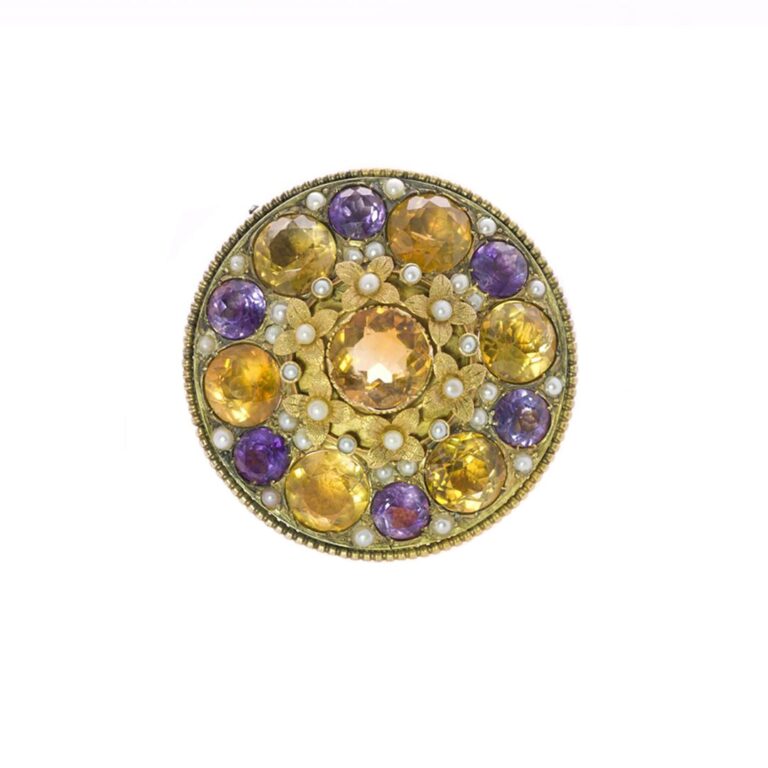

Most of us have one. A pouch, a box, a knotted tangle at the back of a drawer, handed down from a mother or a grandmother and ignored for years. There’s often a strand of pearls in there. Maybe a brooch shaped like something nobody wears anymore. A ring that doesn’t fit. You keep meaning to do something with it, and you never do.
Now might be the moment to look properly.
Pearls in particular are having a real fashion moment, and not the polite kind. Elle called it a “pearlissance”. The strands turning up on the fall runways at Chanel, Givenchy and Simone Rocha are oversized, sculptural, worn over hoodies and slung across bags. Men are wearing them. The whole “polite, conservative, saved for weddings” reputation has fallen away, which means the pieces you inherited are suddenly a lot more wearable than they were when you shoved them in that drawer.
So before you decide the lot is either priceless or worthless, it’s worth sorting it into three honest piles. Wear it. Keep it. Or cash it in.
Start with what you’ll wear first
The temptation with inherited jewelry is to treat all of it as sacred, which is how it ends up in a drawer instead of on your body. The kinder thing, usually, is to be a bit ruthless.
Pull out anything you’d genuinely put on. A single strand of pearls reads completely differently now worn with a white tee and jeans than it did on your grandmother with a twinset. Pearl studs lift a blazer. A drop earring works with almost everything. The trick is to stop seeing these pieces as heirlooms and start seeing them as things you own that happen to be good.
Gold chains, signet rings, simple hoops: these rarely date, and inherited ones are often better made than anything at the same price today. Wear them in, not as a costume, just as yours.
The pieces worth keeping, even if you’re not sure yet
Then there’s the middle pile. The things you don’t wear but can’t quite let go of, and the things you simply can’t identify. You can’t make a sensible decision about a piece until you know what it really is.
Pearls are the classic trap here. A real pearl and a good fake can look nearly identical across a room, and plenty of inherited “pearls” turn out to be glass or plastic. The good news is you can get a reliable first read at home, because genuine pearls give themselves away across several small signs at once. That is the logic behind learning how to tell if pearls are real rather than betting the whole verdict on one test.
Rub two together and a real one feels faintly gritty where a fake slides smooth. Genuine pearls feel cool for a second before they warm to your skin. Held to the light, the glow seems to come from within rather than sitting flat on top like paint. None of this certifies anything, but it tells you whether a piece is worth taking further, and that’s usually the decision you’re trying to make.
This is where most people get stuck, and it’s the pile that matters most. Keep the pieces that pass and mean something. Keep the ones you can’t identify but suspect are good. The rest can move to the last pile.
When it’s worth cashing in, and when it really isn’t
Here’s the part nobody enjoys hearing. A lot of inherited jewelry is worth far less than the family assumes, and pearls are the sharpest example of that gap.
Cultured pearls, which is almost everything sold in the last century, hold their value badly. Appraisers see it constantly: someone arrives certain that a strand of average cultured Akoya is worth thousands, and it simply isn’t. “They usually drop in value, like a car that drives off a lot,” according to appraiser Heidi Harders, president of Chicago Gem & Jewelry Evaluation Services. On the resale market, ordinary cultured strands can fetch as little as a tenth of what they cost new.
The exceptions are worth knowing, because they’re where the money hides. Natural pearls, the genuinely rare ones that formed without any human help, can command extraordinary sums at auction. Well-documented pieces with paperwork do better. So do signed pieces from names collectors chase. And condition matters enormously, which is the argument for caring for what you keep rather than leaving it to knock around a drawer.
This is also where an expert eye earns its money over a price guide or an online calculator. “I look at pearls, I know what they’re going for at wholesale,” according to appraiser and pearl specialist Shawn O’Sullivan. A specialist can tell you in minutes whether you’re holding the ordinary strand or the exception, and that single piece of information changes whether you sell, insure, or simply enjoy.
If you do decide to sell, where you take it matters as much as what it is. A local jeweler will often quote you scrap or trade value, which is the floor, not the ceiling. For anything you suspect is genuinely old, rare or signed, a specialist auction house is worth the trip, because their buyers are the people who pay for those exceptions. Get a second opinion before you accept the first offer, especially if the first offer sounds suspiciously round.
What the drawer is really costing you
The thing about leaving it all untouched is that it isn’t neutral. The wearable pieces go unworn. The valuable ones sit uninsured. And the genuinely worthless ones take up the same emotional space as the treasures, because you’ve never separated them out.
An hour with the box, a few minutes on each piece, and one honest conversation with someone who knows what they’re looking at will tell you almost everything. Some of it you’ll wear tomorrow. Some of it you’ll insure and pass on in turn. And some of it you’ll finally let go of, which is its own kind of relief.
The jewelry your family left you was meant to be used, one way or another. Sorting it is how you find out which way.